

A private journey is sold once. The travellers who want a quiet house, then a camp, then a short expedition are not choosing a departure that already has a name and a date grid. They are asking you to build a trip that will not run again in that form. The proposal has to survive that kind of work. Bespoke itinerary proposal software is useful only if the page stays with the enquiry, so a revision is an update to the same trip, not a new file with a near-identical name.
Most of the trouble starts after the first send. The client asks for a slower day, or a lodge writes back full. Someone makes a new PDF. The old PDF remains attached to an earlier email. A colleague, covering a day off, opens the attachment they can see and quotes the first price. Nobody meant to lose the file. The file was never kept with the enquiry, so losing track of it was the ordinary result.
Fixed departures and trips that will not repeat
A fixed departure can live as one document. You update it for the season, and you send it again. The camps, the vehicle plan and the nights follow a pattern the team already knows. If you send a proposal at all, it mostly confirms what the website has already said.
Luxury operators selling private journeys do not have that pattern to lean on. One brief asks for fewer drives and a house at the start. The next asks for the wilder camps first, and a quiet end. Another wants an expedition pace: longer days, fewer lodge nights, a guide chosen for a language the travellers mentioned only after the first call. A villa week, a yacht leg or a city night may be the trip itself, not a decoration on a standard departure.
Copying last season's proposal feels efficient, and usually is not. Lodge names may overlap. The reasons for the nights will not. A copied document hides which decisions belonged to this enquiry. The client cannot see why the route is shaped this way. Neither can the colleague who inherits the file when the designer is travelling.
The sequence is still plain. Read the brief. Cost what you can actually hold, at the rates you negotiated. Show a trip that matches what they asked for. Then change it, often more than once, without losing what you have already said.
For example, a travel designer costing a private journey might begin with six nights at two camps, then learn that the family wants a third stop and a shorter drive in the middle of the week. The change is normal. What fails is also normal: the revised PDF goes out by email, the earlier PDF stays in the thread, and the held rooms still refer to the first route because the holds were tracked somewhere else.
Bespoke itinerary proposal software, kept on the deal
Safari Studio is a CRM for safari operators, DMCs and the travel agents who sell their trips. Website enquiries arrive on the deals board as new deals, with the email thread linked. The website enquiry form feeds the board, so a new brief does not sit in a folder while someone chooses a spreadsheet. Mail from every synced mailbox sits in one list, each thread linked to its client and deal. Gmail syncs both ways. Any other mail provider can come in through a forwarding address.
Needs reply flags mark threads that are waiting, so a client who has written about a date is not missed because the message landed in the wrong place.
The proposal belongs on that deal. The board already holds the enquiry, the replies and the value of the trip, in any currency, with its value at the day's rate. Stalled deals and unanswered mail are flagged. You drag deals through your own stages, so the board can follow a private journey rather than a fixed departure.
One click turns the costing into the client's own web page: a route map with drive times, lodge photos and a day-by-day story, in your brand. A PDF comes with it. The page is produced from the trip you are costing, so a layout file does not become a second record you have to trust.
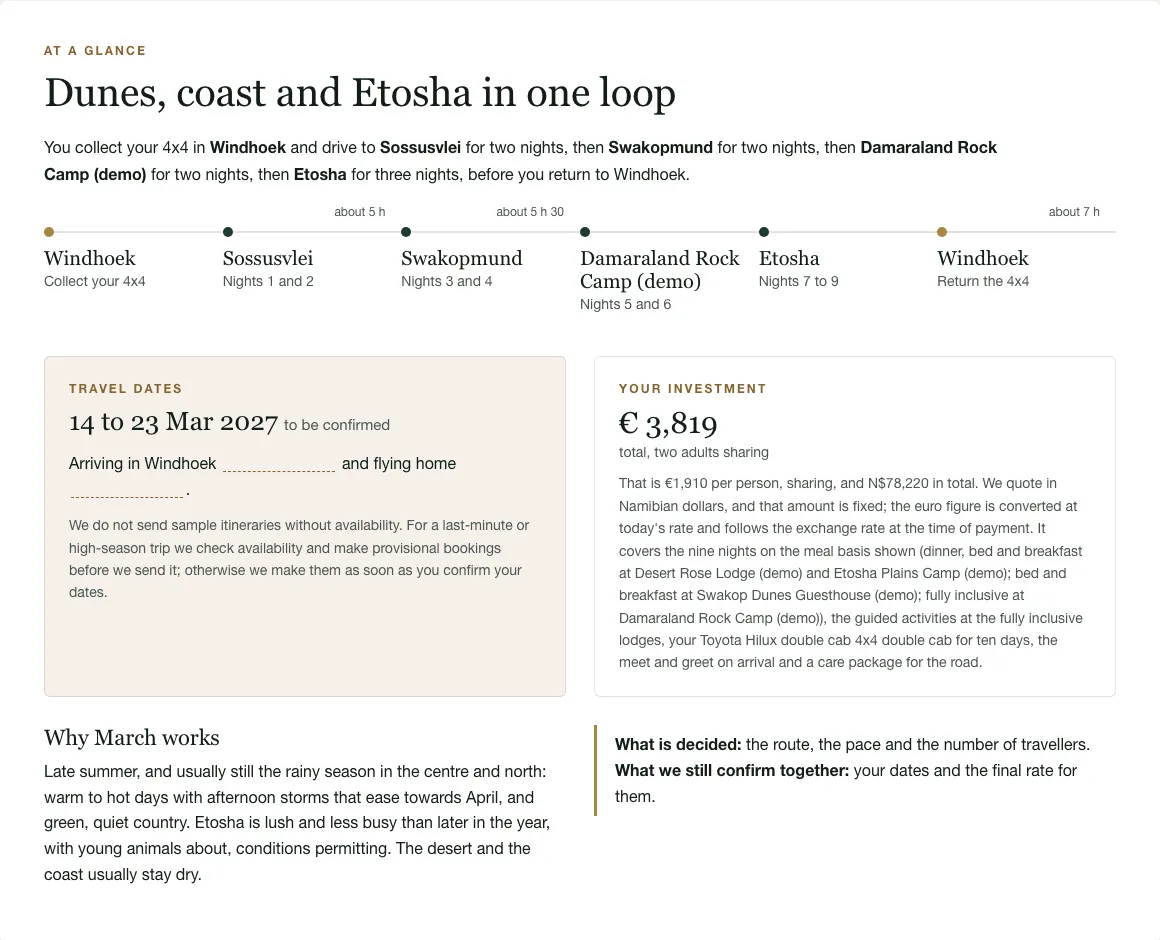
The page the client opens shows the route at a glance, nights per stop, drive times, the travel dates and the price. When you change the costing, you take that same step again. One click turns the revised costing into the page and the PDF. The revision is not a second file saved under a cleverer name. It is the proposal for this enquiry, made again from the work on the deal.
Your logo and colours are on the proposal. On Pro and Max, clients never see Safari Studio on the page. Lite adds a small Powered by Safari Studio line. The same logo and colours can sit on the quote, the invoice and the client form. That is part of branding. The page is in your brand, because the trip you are explaining is yours.
When a revision stops being a lost file
A tailored itinerary is revised because the trip is real, not because the first draft was sloppy. Lodges fill. Dates move. A rate changes. Someone asks to drop a long transfer after seeing how the days sit. Each of those is a reason to touch the proposal. None of them is a reason to open a new folder.
The itinerary changes on the costing. You build it day by day with your lodges, vehicles and activities, at the rates you negotiated. Each amount is stored with the exchange rate of the day, so the margin stays right when rates move. Totals can be shown per adult and in other currencies. A costing PDF is ready to send if you need the numbers in that form. When you revise later, you are not retyping a rate you remember from the first draft.
The proposal changes because it is made from that costing. Drive times between every stop, lodge pages with their own photos, and the day-by-day story come from the trip, in your brand. The client receives the page you have just made, and the PDF that comes with it. You are not searching a downloads folder for the file you hope is latest.
The conversation stays on the deal. The reply that asked for the change sits beside the trip, not only in a personal inbox. Two-way Gmail sync keeps every reply with the trip it belongs to. Mail that arrives through a forwarding address still sits in the one list, linked to the client and the deal. When a colleague opens the enquiry, they see the request and the work that answers it.
What should not appear is another home for the figures. A PDF adjusted so it no longer matches the page. A side list of prices that is not the costing on the deal. That split is how a revision becomes a lost file. The proposal was allowed to leave the enquiry, and from then on every copy is a candidate for the current one.
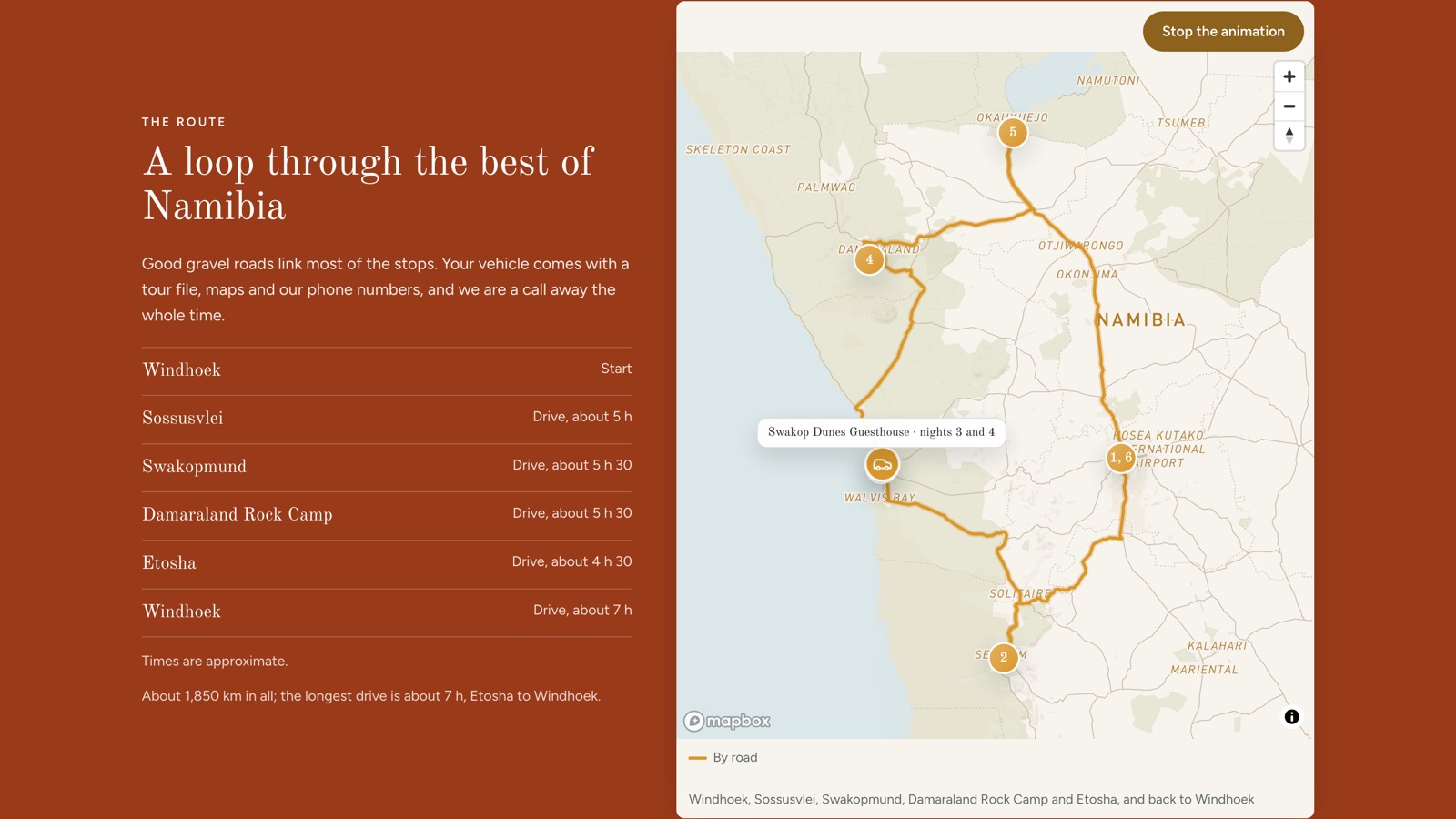
On a route that has never been run as a package, drive times between every stop show whether the week is actually well paced. If the client asks to move a night, you change the costing, turn it into the page again, and leave the email that explains it on the same deal.
Holds, the vehicle and the invoice
The proposal is what the client reads. It is rarely the only record you need while the trip is undecided.
While nights are still moving, you may already have asked lodges to hold space. On the holds board, every room you ask for sits as requested, held with an expiry date, confirmed or released. Hold requests go to each lodge from the deal. Before a hold runs out, a chaser email is ready to go, so nothing lapses quietly. If a revision takes a camp off the route, that hold is visible on the same trip and can be released.
A private journey can still clash on vehicles. It can overlap another private trip, a service day, or a date you have blocked. The fleet timeline shows every vehicle on one line, with trips as bars across the dates, and services and blocked days on the same line. Assign a car to a trip and the clash shows before it happens, which is the right moment: before that vehicle is written into the proposal.
Quotes are made from the costing. They become deposit and balance invoices, with a card payment button, in any currency. Every payment is tracked against the deal. You can see what is owed and what is paid, with no spreadsheet to keep beside the proposal. Late payments are grouped by how late they are. The invoice comes from the costing the proposal was drawn from, not from an old PDF someone reconstructs by hand.
The page you send, and what it will not decide
Clients on this kind of trip share what you send. One person took the call. A partner reads it later. A web page can be opened from the link you sent. A PDF can be opened if the reader still has that file. The page is the client's own web page, and the PDF comes with it, produced from the same costing, in your brand.
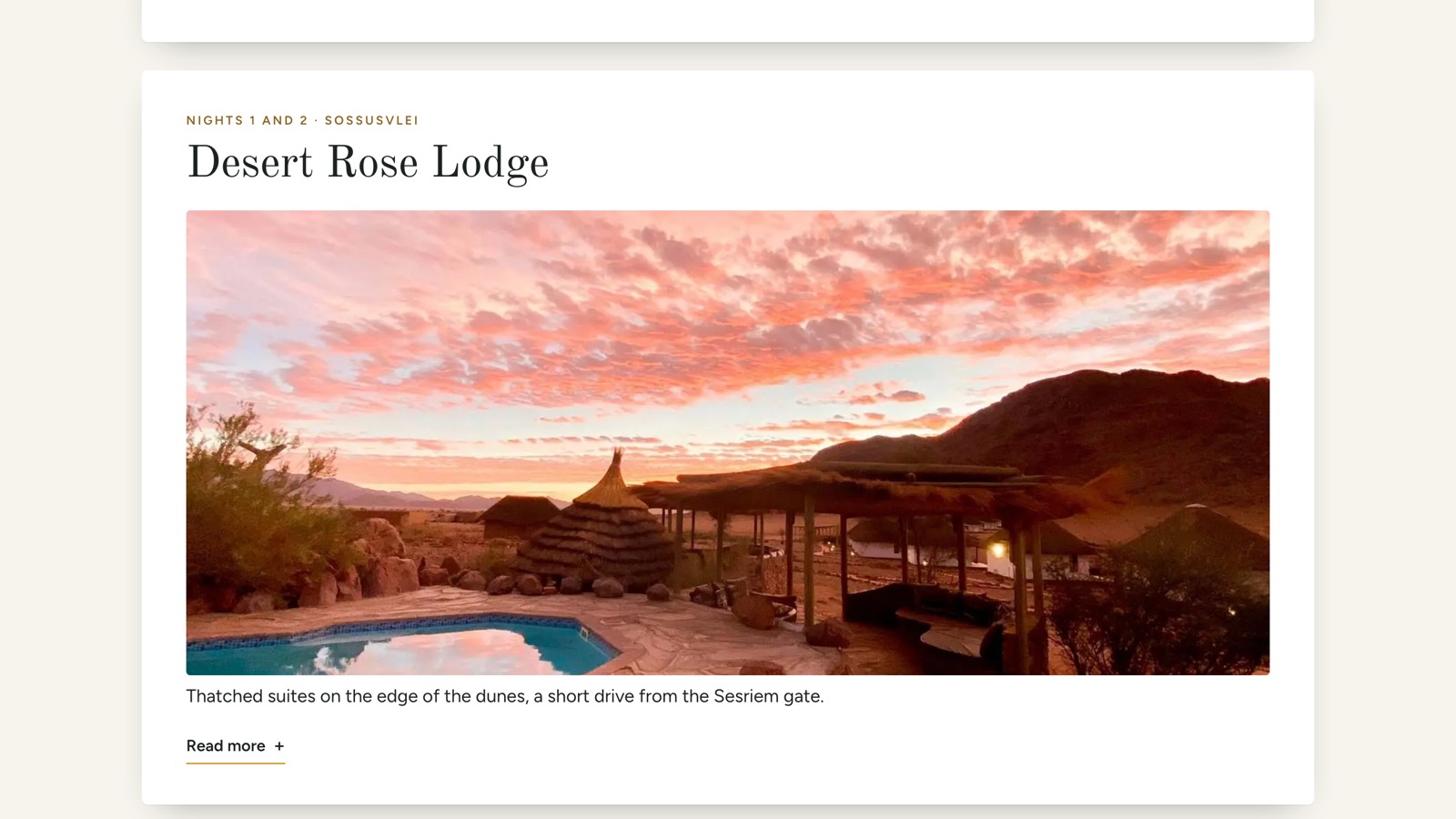
Lodge pages, with their own photos, are where a stop becomes a place. On a trip with no series name, the client is deciding whether these nights, in this order, are the journey they described. You still write the day-by-day story. The software does not choose the reasons for the route. It keeps the route, the photos, the drive times, the dates and the price with the enquiry the story belongs to.
It will not decide that a family should skip a transfer, or that a quiet house belongs at the end rather than the start. That judgement is the work. What the CRM takes off the team is the split between documents. You should not need a second system to remember which proposal is current. You should not find a lapsed hold because the proposal lived in email and the hold lived in a notebook.
Plans and prices are on the pricing page. The subscription can be monthly, quarterly or yearly, and the free trial does not ask for a card.
If the proposal leaves the enquiry as soon as it is designed, the next change will be another file, and the file is what people lose. Cost the trip on the deal. Turn that costing into the client's page. Leave the replies where the page was made.
Book a demo if you want to walk a one-off journey through the board, or start a free trial if you would rather put a live enquiry on the deal and see the proposal come off the costing.