

Ask a reservations desk how they handle dmc itinerary costing and the honest answer is often a copy of last season's workbook. The dates change, a few lodge names change, and someone pastes the old rates into a new sheet. Activities and transfers are meant to be checked in the same pass. The total still goes out with a line that belongs to a different party, a different camp, or a contract that has since moved.
Owners, reservations managers and consultants are careful. The method is the problem. A quote rebuilt by hand has no memory of where each figure came from, so the next person cannot see which season's contract it used, or whether the transfer at the bottom still belongs to this guest.
DMC itinerary costing still starts with last season's file
Before the season turns, last year's quotes are on a shared drive, filed by client, by month, or by whoever built them. The useful file is rarely labelled as the master. It is the one a colleague remembers as right for high season, or the sheet with a lodge rate card pasted into a tab called Rates.
Copy the file. Change the dates. Change the party. Type this year's accommodation over last year's. Do the same for activities and transfers. Check the total. Send it. That is the whole method, and the mistakes live inside it. A shoulder rate stays inside a high season week because the cell sat outside the range you overtyped. A road arrival becomes a flight connection, and the old transfer remains in the sum. An activity priced per person is copied for a couple, then the party becomes four and only the beds are updated.
Owners feel slow quotes, and a result that does not match the file once the supplier invoices. Consultants feel the hour before an agent expects an answer. Reservations managers feel the same check on every file, because nothing in the sheet proves the rates are this year's.
Later corrections repeat the risk. A revised rack or a changed transfer leaves the sent PDF, the working sheet and the contract email in three places. Two people copying the same file that morning will not produce the same quote by the afternoon.
What slips when accommodation, activities and transfers part company
A safari quote is not one price. It is nights, movements, and the things people do between camps. Lodges often work at rack, with commission agreed beside it. An activity may be per person. A vehicle may be per day, and a transfer may be a single leg with its own supplier.
In a rebuilt sheet those pieces sit wherever there was room: accommodation on one tab, activities on another, transfers in a block added two seasons ago so as not to disturb the print area. The total is a formula if the file has been looked after. If it has not, it is a number typed after a calculator pass that the file does not keep.
The client version can then say three nights at the second camp while the cost tab still has two, because the extra night was written into the wording and not into the sheet. Or the transfer is in the story and missing from the cost. The trip looks bookable, and the margin is a guess.
Accommodation, activities and transfers need to travel as one costing, attached to the enquiry. A file that can be copied without its context will be. By the third amendment the quote and the costs have drifted. An agent who asks to swap a camp or drop a morning activity forces the copy and rebuild again, and you have two totals in the world and one trip.
Park fees and similar charges often sit in a notes column nobody opened, because the copy was focused on the lodge rates that had just arrived. Those amounts change by park and by year, so they do not belong in a sample table here. A charge with nowhere stable to live is the one that gets missed.
For example, a lodge operator in the Okavango
Take a clearly labelled example, not a named client and not a result we are claiming. A lodge operator in the Okavango also builds a few private itineraries for guests who want more than a single camp. A consultant asks for six nights in August for two adults: three at the operator's own camp, three at a partner camp further into the delta, a light aircraft link, one guided activity on the water, and transfers at each end by boat or by vehicle, depending on the water and the airstrip.
On a call that is a short trip. In the sheet it is a reconstruction. Last August's file is the base, because August sits in peak. The partner rate is an email filed under the camp, not under this guest. The activity cell is still per person, which is right until a companion is added and the beds change but the activity does not.
Transfers are the lines most often left behind. Last year's guest was met at the airstrip. This year's guest connects from another concession, so the arrival is a different movement, on a different day, with a different supplier. The old line stays in the total because a number in a transfer column looks as if it belongs.
One stale rate is enough. The quote goes out, and weeks later the partner camp invoices the current rack. The difference lives only in a conversation about whose sheet was wrong. The operator knows the camp and knows which activities the water will allow. What they lack is a costing that already holds this year's rates for both lodges, the movements and the activity, beside the quote. An extra night or a swapped camp, done as a new row and a scaled total, is how the transfer gets left out.
Rates stored with the lodge, not in last year's cell
Structured costing starts before the quote. The rates you negotiated sit with the supplier, by year and by season, not inside the client file that last used them.
Safari Studio stores a lodge's rates by year and by season: low, shoulder, high and peak, with the commission. When August comes round you read the season already filed against that lodge, instead of hunting a cell in last August's workbook.
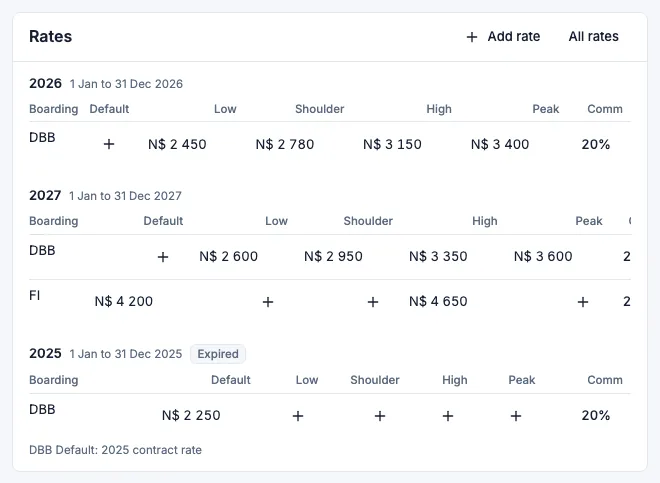
A new contract is an update on the lodge, for that year and that season. The next quote is built from those rates, not from a PDF each consultant may or may not have pasted into a private file. Commission stays visible beside rack. If the rack moves and the commission does not, both are still there. A single net figure typed over the top cannot tell you which of the two changed.
Vehicles and activities are not a lodge season card. They are costed on the days they run, at the rates you negotiated. In the Okavango example the changed transfer is a vehicle line for this trip, not a number inherited from a guest who arrived another way. That is what building the costing from the rates you negotiated means: lodges, vehicles and activities, day by day, each amount stored with the exchange rate of the day so the margin stays right when rates move.
Day by day, still attached to the quote
The editor holds the client's details, the accommodation day by day at rack rates with commission, and the cost summary. One screen, not three tabs.
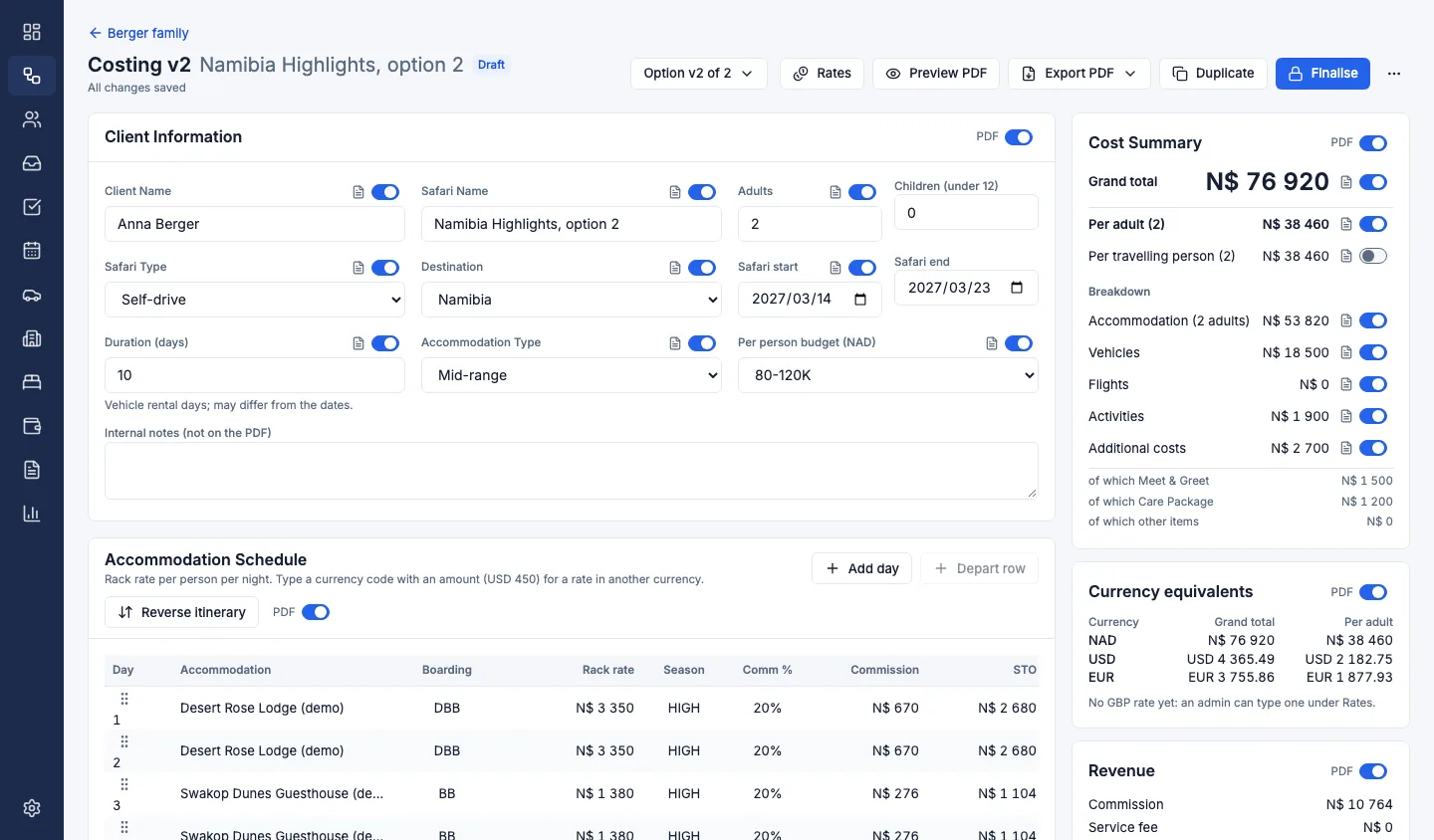
For the Okavango week, each camp's nights are lines on the days they occur, at the rack for the season stored against that lodge. The activity sits on its day. The vehicle movements sit on theirs. Another night is another line, not a row you hope an old formula still includes.
The costing belongs to the deal. On the deals board a website enquiry arrives as a new deal, with the email thread linked, so a reply that swaps the second camp is an edit to this costing rather than a new file. A hold request goes to the lodge from the deal. On the holds board each hold shows its expiry, with a chaser email ready before it runs out, and requested, held, confirmed and released are visible at a glance. The costing says which nights the quote uses. The hold says whether those nights are reserved.
The summary the desk can stand behind
The summary shows the grand total, the amount per adult, the breakdown, currency equivalents and the internal revenue.
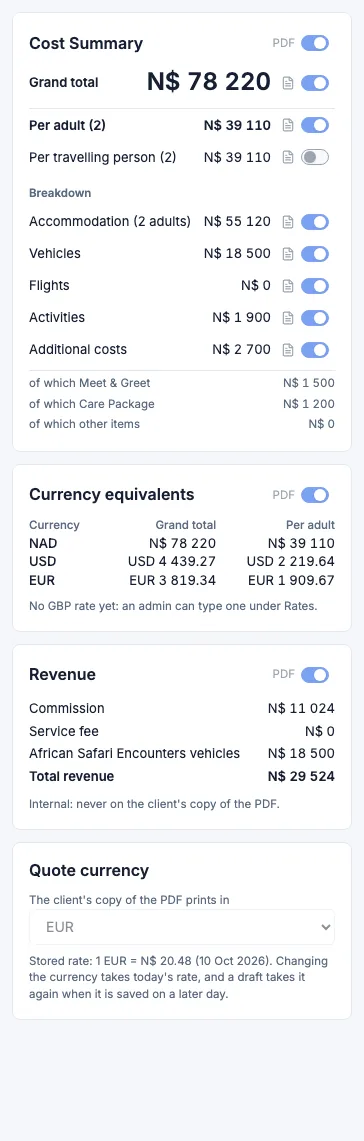
Each amount is stored with the exchange rate of the day, so the margin stays right when rates move. You may quote in one currency and pay suppliers in others. The rate on the line is the rate of the day you entered it. Totals per adult, and totals in other currencies, come from the same summary. A costing PDF is ready to send from those lines, so the PDF and the schedule are one version. A sample grand total would only fake a margin, so there is not one here.
From the costing to what the client reads
Quotes made from the costing become deposit and balance invoices, with a card payment button, in any currency. Payments are tracked against the deal, so owed and paid are visible without a second spreadsheet. Late payments are grouped by how late they are.
One click turns the costing into the client's own web page: a route map with drive times, lodge photos and a day-by-day story, in your brand, with a PDF alongside. The nights you costed are the nights in the story. Drive times make a transfer concrete for someone who has not stood on that airstrip.
Logo, colours and theme go on the proposal, the quote, the invoice and the client form. On Pro and Max, clients never see Safari Studio anywhere on them. Lite adds a small Powered by Safari Studio line. Which you are on is set out with the other plans and prices, not redesigned for every quote.
You stop opening last season to steal its rates, and you stop treating transfers as homework after the lodges look done. Stalled deals and unanswered mail are flagged, and mail from synced mailboxes sits in one list, each thread linked to its client and deal, so a revised rate card lands beside the trip.
Safari Studio is a CRM for safari operators, DMCs and the travel agents who sell their trips. The subscription is monthly, quarterly or yearly, with a free trial and no card needed. It will not negotiate your contracts or judge the water. It keeps the rates you have agreed, and the days you apply them to, with the quote.
If you are still rebuilding every quote from last season's sheet, book a demo and walk through a trip the way your desk costs it, or start a free trial and put one live enquiry through day by day.