

If you search for a crm for tour operators, you will meet two sorts of software, and they are easy to confuse because both use the word CRM.
One sort is a general sales CRM. Salesforce, HubSpot and Pipedrive are the names most owners already know. They are built to track people, deals and follow-up, and their public product pages describe that job clearly. The other sort is built for the way a safari trip is sold: lodges, rates and holds, with the deal wrapped around them. Safari Studio is in that second group. It is a CRM for safari operators, DMCs and the travel agents who sell their trips.
The gap is not a matter of taste. A reservations manager can keep contacts tidy in a general CRM and still have no reliable place for the rate a camp charges in peak season, or for the date a provisional room falls away. This article compares the two, feature against feature, and only where the comparison can be checked.
What a general sales CRM is built to do
Start with what these products are actually for, because the comparison is unfair if you pretend they are weak at their own job.
Salesforce Sales Cloud, on its public pages, is organised around leads, accounts, contacts and opportunities, with forecasting and tools for adding your own objects. HubSpot's public CRM pages centre on contacts, companies, deals, pipelines, tasks and email, including a free tier. Pipedrive's public pages centre on a visual pipeline, activities and email, with custom fields so you can store extra detail on a deal.
Used as intended, they are calm and capable. A deal has a name, a value, a stage and a next task. Mail sits on the record. Reports show what is in each stage. For a team selling a simple product, that is the whole job, and these products do it well.
A safari operator can use that shape, up to a point. Enquiry, quote, confirmed, travelled: those stages make sense. The trouble starts when the deal is not a single product with a single price.
None of those public pages describes a lodge rate card by year and season, a room hold with an expiry, or a costing built night by night from negotiated rates. That is not a slight. If you need those objects, the usual path is custom fields and a spreadsheet, and the habit of copying figures across. It works until the person who knows the sheet is away, or two people update two copies.
What a crm for tour operators has to store
A trip is a bundle of promises to other businesses.
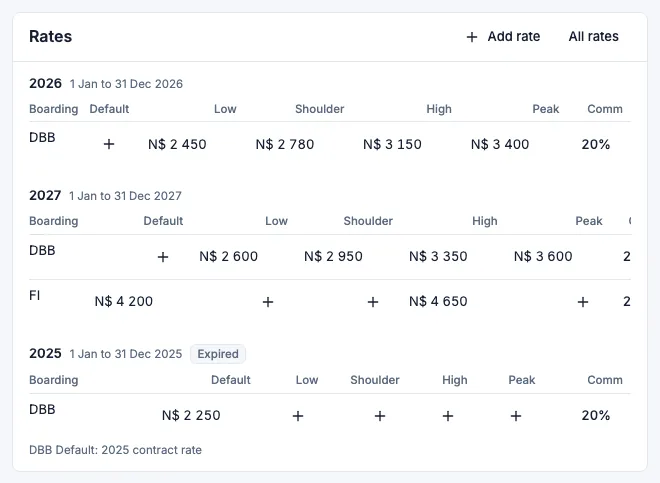
Take a September departure sold by a DMC, for example, for a family who want the delta and then the desert. The reservations manager is holding nights at more than one lodge, a vehicle and a guide, a few activities, and the fees around them. Each lodge has a contract for the year. Inside the year the price changes by season: low, shoulder, high and peak. Commission sits on the rate.
A general deal can store the total you hope to charge. It cannot, as those products are described on their own pages, store the rate card and apply it. A note that says Camp X, peak, two rooms, rack less commission, is still a note. The next quote starts from that note, from an old email, or from a spreadsheet.
Ask the system, not a colleague, what you charge for this lodge on these nights, and what commission sits on it. If the answer is a search through mail, the CRM is holding the conversation about the rate, not the rate.
Safari Studio stores the lodge's rates by year and season, with the commission, and the costing uses those rates.
Supplier costs and the client price are often in different currencies. Safari Studio stores each amount with the exchange rate of the day, so the margin stays right when rates move. Salesforce, HubSpot and Pipedrive describe multi-currency on the deal, and Salesforce documents dated exchange rates on opportunities. That converts a deal total. It does not, on those public pages, keep the day's rate on each lodge, vehicle and activity line, which is where a safari margin is won or lost.
Rates, commission and the day-by-day costing
Once the rates exist as records, the costing is a schedule, not a sum you type in.
You build it day by day with your lodges, vehicles and activities at the rates you negotiated. The editor shows the client's details, the accommodation schedule day by day at rack rates with commission, and the cost summary. Many lodge contracts work this way: a published rack rate, an explicit commission, and a price that depends on the night. A single product price in a general CRM does not show those three things on one line.
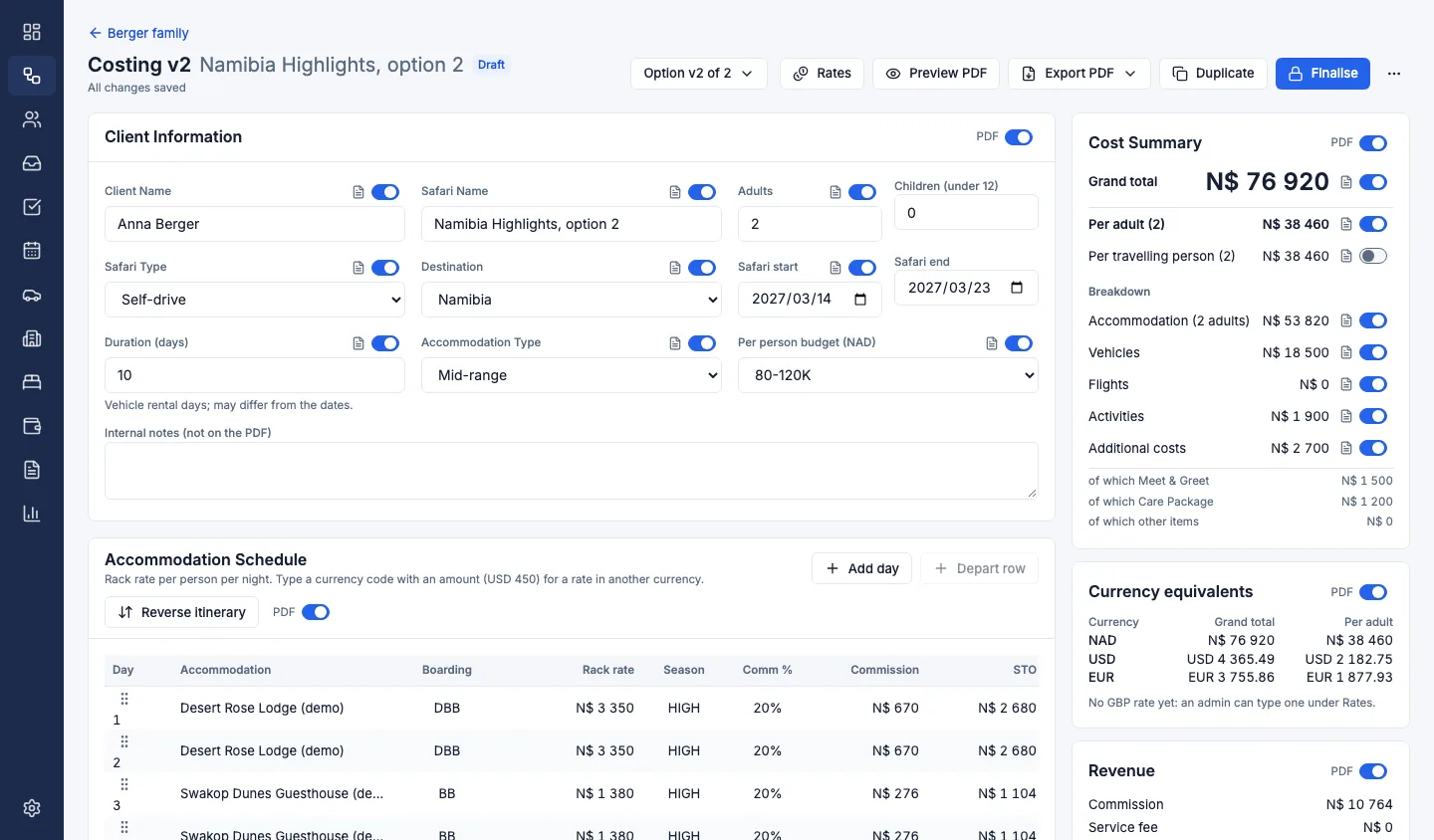
You can build the costing day by day from the rates you negotiated, then read the summary: grand total, amount per adult, the breakdown, currency equivalents and the internal revenue. Per adult is how clients and agents compare trips. Currency equivalents let you speak in the client's currency while a lodge invoices in another.
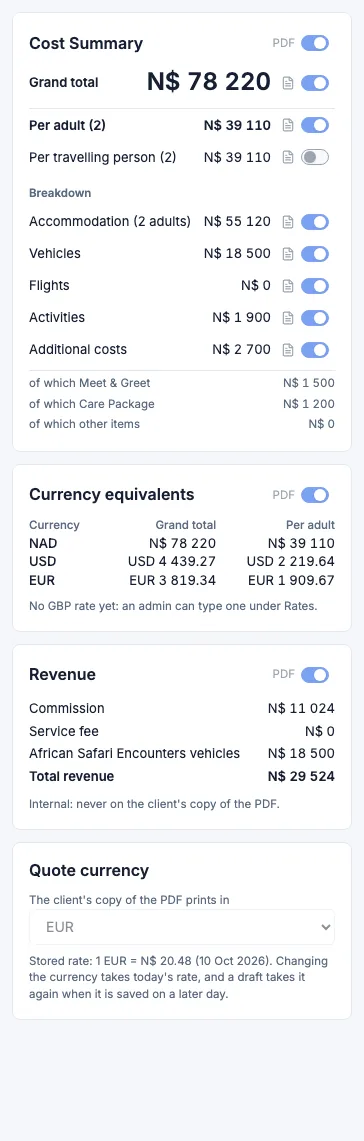
A costing PDF is ready to send. From that costing, quotes become deposit and balance invoices in any currency, with a card payment button, and payments tracked against the deal. HubSpot and Salesforce publish quoting tools, and Pipedrive publishes products on deals, so a general CRM can raise a price. The fair difference is the source. Their quote comes from a catalogue you maintain. Safari Studio's comes from the day-by-day schedule and the lodge rates already stored.
One click turns the costing into the client's web page: a route map with drive times, lodge photos and a day-by-day story, in your brand, with a PDF. Your logo and colours are on the proposal, the quote, the invoice and the client form. On Pro and Max, clients never see Safari Studio on them. Lite adds a small Powered by Safari Studio line. Plan details are on the pricing page.
Compare the source of the numbers, not the presence of a file. A product catalogue does not know why one night at a lodge costs more than another, unless you have built that knowledge in yourself.
Holds are not tasks with a nicer name
Rates tell you what a night costs. Holds tell you whether you still have the night.
When you ask a lodge for rooms, the status is requested. If the lodge agrees to keep them, it is held, with an expiry date. Then it is confirmed or released. A hold that lapses quietly is a trip you have described to a client, built on rooms you no longer have.
Salesforce, HubSpot and Pipedrive publish tasks and due dates, and they are good at reminding a person. A task that says to chase the camp does not know which rooms, which nights, or whether the lodge has replied. It does not move from requested to held to confirmed. The task belongs to a person. The rooms belong to the departure.
Safari Studio keeps every room you ask a lodge for on a holds board: requested, held with an expiry date, confirmed or released. Hold requests go to each lodge from the deal. Before a hold runs out, a chaser email is ready to go, so nothing lapses quietly. You see every hold with its expiry, chased in time.
A reservations manager, for example at a small operator in the Okavango, may have holds out at several camps in the same week. A task list says to check holds on Friday. The board shows which expire, which are still only requested, and which the lodge has confirmed.
A pipeline stage called Hold is only a label. It does not expire, and it does not belong to a room. The board is described on the holds board for lodge rooms.
Where a general CRM and a safari CRM overlap
Owners who use HubSpot or Pipedrive are right to ask if they will lose the pipeline and the mail. They should not have to.
Mail from every synced mailbox sits in one list, each thread linked to its client and deal. Website enquiries arrive as new deals. Gmail syncs both ways, and any other mail provider can come in through a forwarding address. Needs reply flags mark a waiting client. You drag deals through your own stages. Stalled deals and unanswered mail are flagged. A deal can sit in any currency, with its value at the day's rate.
That should feel familiar. The point is not a new word for a pipeline. It is that the pipeline sits on lodges, rates and holds. See mail linked to the client and the deal and enquiries arriving as deals.
One neighbouring record is worth naming, because those public pages do not describe it. Every vehicle sits on one timeline with its trips, services and blocked days, and a clash shows before a 4x4 is booked twice. Invoices stay on the same deal as the costing. Neighbours, not the test. The test is still lodges, rates and holds.
Questions worth asking of both
Bring a real trip and ask both products the same things.
- Can you store this lodge's rates for the year, by low, shoulder, high and peak, with commission, and quote from them without a spreadsheet?
- Can you cost the trip day by day, with vehicles and activities, and see a total per adult in more than one currency?
- Does each amount keep the exchange rate of the day?
- Can you see every room hold, its expiry, and a chaser before it lapses?
- Does a website enquiry become a deal with the mail attached?
- Can the costing become a proposal in your brand, with drive times and lodge photos?
If the general CRM's answer is a custom field or a sheet, that is a cost in copying. Salesforce is built so a team can add objects, and HubSpot's higher tiers publish custom objects, so you can try to build this. It remains a project, and someone has to own it. Software that already has the screens is simply further along.
If what you mostly need is a wide marketing suite shared with other teams, a general CRM may still be the right primary system. Safari Studio is not that suite. It is for the safari sale: enquiry, lodge, rate, hold, costing and invoice.
Seeing it on a real trip
Bring a trip you have already quoted. Enter one lodge's seasons, cost a few nights from those rates, and place a hold with an expiry. If those steps are native, the software understands the work. If they are workarounds, it is a general CRM with safari words added on.
Safari Studio is a monthly, quarterly or yearly subscription, with a free trial and no card needed. Book a demo to walk a real trip through lodges, rates and holds, or start a free trial and try it on your own rates.