

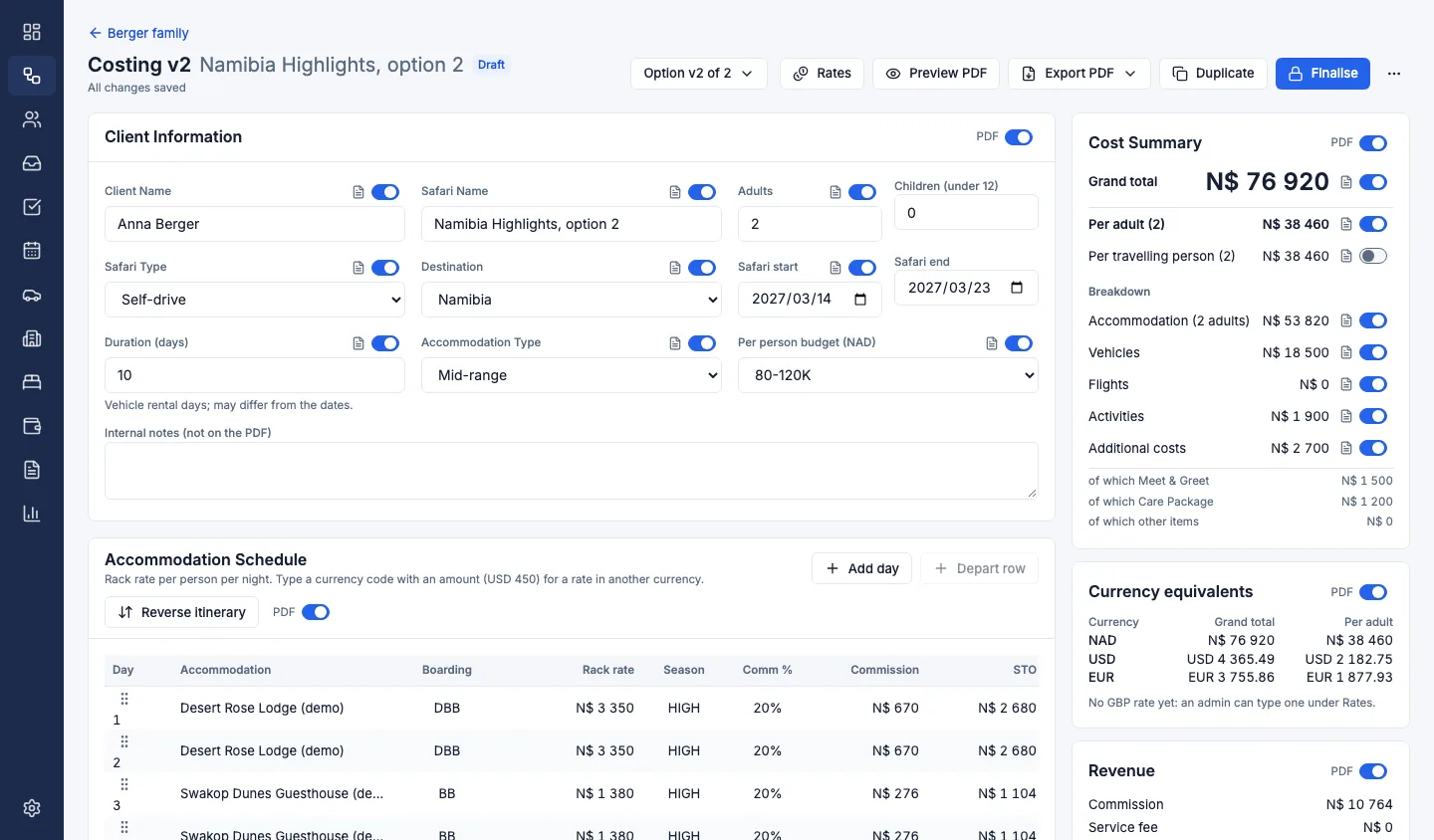
You can price a lodge in Namibian dollars, a vehicle in the same currency, a guide fee in rand and a delta camp in pula, then send the guest a figure in euros. The arithmetic is ordinary. The risk sits in what you do with the rate. Safari quote exchange rates are easy to treat as a single number at the top of a spreadsheet. They are not. Each amount was true on a particular day, at a particular rate, and your margin is only honest if that rate stays attached to the amount.
A reservations desk feels this between the quote and the deposit. The lodges have not rewritten their contracts. Yet the margin that looked sound on Monday looks different on Friday, because a currency cell was refreshed, or because the invoice was converted again by hand. Storing the day's rate with each amount is how you stop that quiet rewrite.
Why safari quote exchange rates belong with the amount
A quote that crosses currencies has two jobs. It tells the guest what they will pay. It tells you whether the trip still earns what you planned once every supplier is paid. Those jobs pull apart when the rate moves and the file does not remember the rate you used.
The familiar version is a costing built on Monday and reopened on Thursday. Someone refreshes a currency cell so the numbers look current. The margin percentage moves even though no supplier price changed. The trip did not become more expensive to deliver. The memory of the rate was overwritten.
Storing the day's rate with each amount is the plain correction. The lodge rate you negotiated stays in the currency the lodge will invoice. Beside it sits the exchange rate of the day you costed that line. The figure in the guest's currency is the result of those two facts. If the market moves on Friday, Monday's line does not silently rewrite itself.
Three facts, not one cell
Every converted line is three facts.
The supplier amount, in the currency you will be invoiced in. A camp in the Okavango may bill in pula. A vehicle company in Windhoek may bill in Namibian dollars. An activity operator may bill in rand. For example, a lodge operator in the Okavango and a vehicle supplier in Namibia do not become one currency because the guest lives in Hamburg.
The rate of the day, stored with that amount, not written once in a header for the whole file. Two lines entered a week apart can carry two rates. That is the record of when each cost was accepted. A single header cannot tell that story.
The guest amount, which those two facts produce in the currency of the quote. Change either input and the output should change. Leave both alone and the output should stay still, even if a bank's published rate has moved.
Keep only the guest amount and you cannot walk backwards when the supplier invoice arrives. Keep only the supplier amount and convert live, and every opening of the file is a new quote.
What a single rate at the top of the file does
A header rate feels tidy. One cell, one place to update, one number to mention to a colleague. It is enough when every supplier bills in the guest's currency and the quote is accepted the day it is built. Safari files rarely sit in that narrow case.
A DMC may assemble lodges, a private vehicle, a guide and several activities, each contracted in a local currency, then quote a family in dollars, euros or pounds. A travel agent selling the trip may think in another currency again. On the deals board a deal can sit in any currency, with its value at the day's rate. That is the right place for the value of the opportunity. It does not replace a line-by-line memory of how each cost was converted.
The failures are ordinary. You edit one lodge and the sheet reconverts every line at today's rate, so you reprice the whole trip without deciding to. The PDF sent on Tuesday no longer matches the file. If the guest accepts the PDF, you are agreeing a number your working copy has already left behind.
Or you freeze the header and refuse to touch it. New costs added next week are converted at a stale rate. You might be safe. You might be giving the move away, or taking it, with no note of which. Or two people share the file and one updates the cell, because a cell looks as if it wants a current rate.
Copy the quote to raise a deposit, and a new rate can slip in with the copy. The deposit is no longer a portion of the agreed price. It is a portion of a different price. The guest may pay it without comment. Your margin absorbs the difference without a name for it.
A small move is enough. Applied to accommodation, a vehicle and a few activities, then read per adult, it can make a comfortable quote look thin, or a thin quote look comfortable. The percentage on a summary is only as trustworthy as the rates underneath it.
How a stored day's rate changes the costing
In costing that stores the exchange rate of the day with each amount, you build the trip day by day: lodges, vehicles and activities at the rates you negotiated. Each amount is stored with that day's exchange rate, so the margin stays right when rates move. Totals can be read per adult, and in other currencies, without a side sheet whose only job is to convert and split. When the numbers are settled, a costing PDF is ready to send.
You convert as you enter, and you keep the conversion, not only the result. The result is what the guest sees. The conversion is what lets you defend it.
A line entered today keeps today's rate. A line you add next week keeps next week's. That is the whole discipline. If a euro total moves, the supplier amount changed or the stored rate was replaced. You should not have to reconstruct the afternoon from sent mail. If a guest compares your figure with the rate on their phone, you can say the quote uses the rates stored when the costs were assembled. A moving rate is not an editor of a price you have already built.
Read the summary as a check
The summary is where you look, not where conversion should happen for the first time.
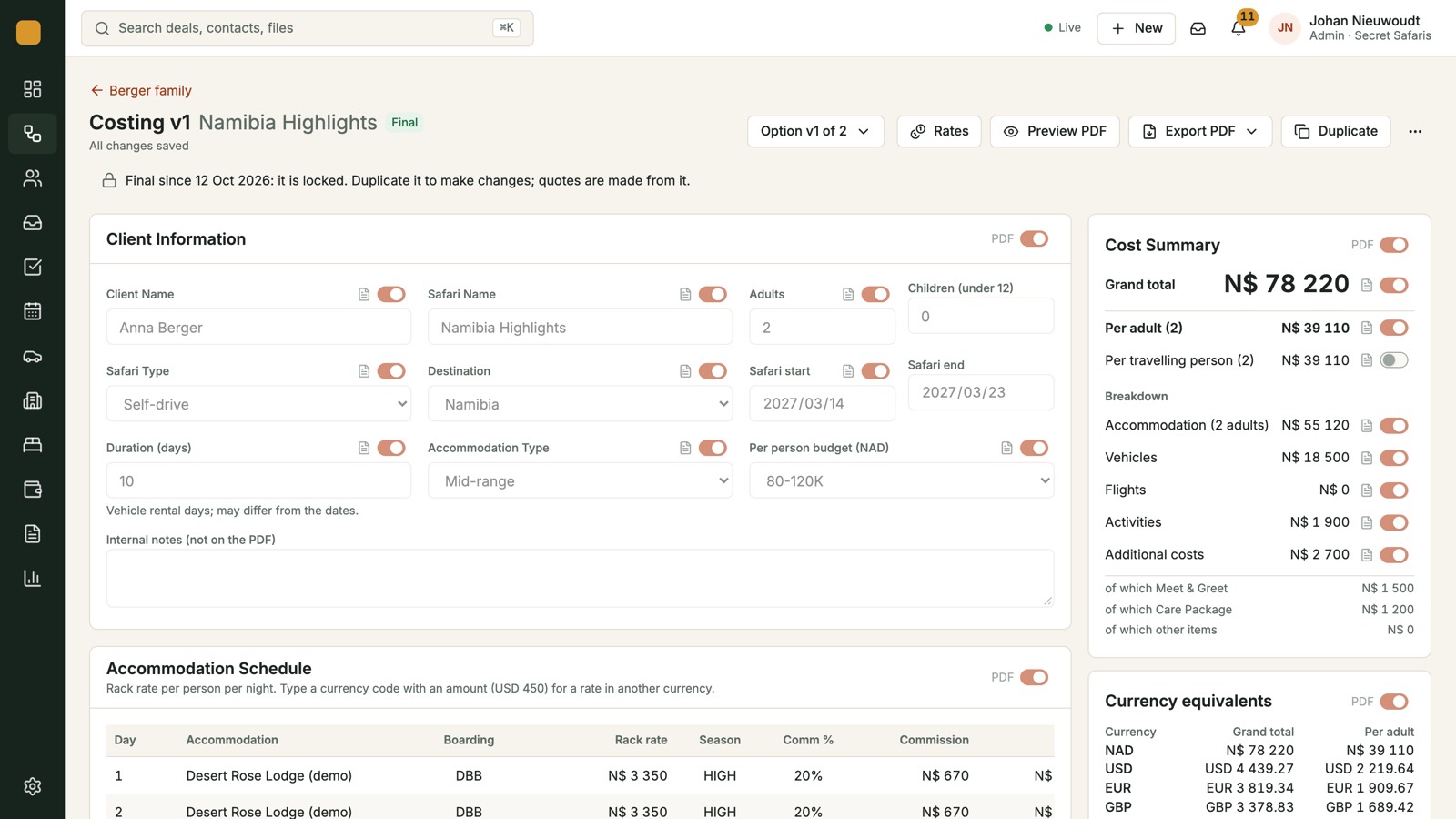
The screen above is a worked costing, not a claim about what your trips earn. It shows a grand total in Namibian dollars, the amounts per adult, and the split into accommodation, vehicles, activities and additional costs. Accommodation is usually the large block. A vehicle often will not divide neatly by the number of guests, because you buy it as a vehicle. Activities and additional costs are where a transfer, a park fee or an extra guiding hour hides. If those blocks were converted on different days, the grand total stays meaningful only when each block still carries the rate that produced it.
Use the per adult figure as a sense check against the quote you are about to send. Use the other-currency totals when the guest, the agent and your accounts do not share one currency. Another currency should be another reading of the same stored amounts and rates.
From the costing to the deposit and the balance
The guest pays a quote, then a deposit, then a balance. Retype each one and a colleague can refresh the rate at every step.
Quotes and invoices are made from the costing. Deposit and balance invoices can be raised in any currency, with a card payment button, and every payment is tracked against the deal, so you can see what is owed without a side spreadsheet. Late payments are grouped by how late they are. That is a cash view, but it meets the rate question when someone reissues a late balance at today's rate to make the numbers look current.
Reissuing at a new rate is a decision, and it should look like one. A fair reason is a guest who asks to pay in another currency, a supplier who reissues a contract in another currency, or a departure you deliberately reprice before it is sold. Enter the new fact with the rate of that day. Do not paint over the old line.
The same costing can become the page the guest reads. One click turns it into a route map with drive times, lodge photos and a day-by-day story, in your brand, with a PDF alongside. That is the proposal built from the costing. Keep the words and the numbers from the same place, and keep the quote currency stable: match the deposit and the balance to the accepted quote unless a change is agreed in writing.
Habits worth keeping
Enter supplier amounts in the contract currency. Decide what the day's rate means in your office, whether that is your bank's morning rate or a rate plus a buffer you can point to, and then stop refreshing it on quotes already accepted. When a camp changes its price, change the supplier amount and store the rate of the day you accept the new cost. Keep vehicles, guide days and private activities whole: per adult figures are a reading, not the only copy of the contract.
If a move favours you, you are not obliged to hand it back unless your terms say so. If it goes against you before the guest accepts, you can reprice, hold the price, or let the quote lapse. The stored rate lets you see the size of the move before you choose. A feeling that the rate changed is not a figure.
A labelled example
This is a labelled example, not a customer. A consultant at a DMC takes a website enquiry for a family crossing Namibia and northern Botswana. It arrives on the deals board as a new deal, email thread linked. The guests want euros. An agent wants rand. Suppliers will still invoice in Namibian dollars and pula.
She costs the days: lodges, a vehicle, a guide, a camp activity, park fees, each amount stored with the rate of the day she enters it. Euro, rand and per adult totals are readings of those pairs. A lodge swap changes one line, at the rate of the day of the swap. The quote, the euro deposit and the later balance all come from that costing. When the camp invoice arrives, a higher pula figure is a supplier difference. A matching figure, after the currencies have moved, is a rate difference. It does not rewrite the family's price. She can name which is which.
Where to start
You do not need to rebuild old seasons this week. On quotes not yet fully invoiced, put the supplier amount in the contract currency and attach the rate you will stand behind. If the original rate is lost, do not invent one. Note the gap and treat that older margin as an estimate.
Safari Studio is a CRM for safari operators, DMCs and the travel agents who sell their trips, billed monthly, quarterly or yearly. Plans and prices sit on their own page. To see the day's rate stored on your own lines, book a demo or start a free trial. The trial needs no card.