

A luxury travel CRM earns its place when the client still feels known. Owners and travel designers who plan private journeys, villas, yachts and expeditions are right to be wary of software that turns a careful relationship into a sequence of stages. The work is high touch. A family may take weeks to agree dates. A yacht week may hinge on one harbour and one captain's note. A villa booking may rest on a promise you made on the phone. The record should hold that care.
Safari Studio is a CRM for safari operators, DMCs and the travel agents who sell their trips. The same habits suit a studio whose work is private travel: one client, one deal, and the mail still sitting beside the journey it belongs to. The system is where you look, so you do not have to ask them to repeat themselves.
Why a luxury travel CRM should feel like a studio
Most of the worry about software is really a worry about tone. A tool built to push volume will nag you to chase. A studio that designs a private journey often does the opposite. You wait, because the client is checking a school term, a board meeting, or whether the yacht can take the extra cabin. Silence is sometimes respect.
What you cannot afford is silence on your side that comes from losing the thread. A note about a shellfish allergy, a preferred cabin, the name of a child, the fact that they hated the last transfer: these live in old emails if you are lucky, and in your head if you are not.
A luxury travel CRM, used as a studio tool, is a memory with a date on it. Website enquiries arrive on the deals board as new deals, with the email thread linked, so the first message is not stuck in a folder nobody owns. You drag deals through your own stages. That matters more than it sounds. A high-touch pipeline is rarely a generic ladder. It might run from first conversation, to shaping the route, to rooms requested, to a proposal with the family, to deposit. Your words, not a script the software expects you to perform.
Stalled deals and unanswered mail are flagged. Any currency can sit on the deal, with its value at the day's rate. That is simply practical when parts of a private journey are priced in different currencies.
What they should never have to say twice
Personal service is mostly accuracy, repeated quietly. For example, a designer arranging a private yacht week, then a villa, then a short lodge stay, will have gathered preferences across several messages. The client should not have to restate the early nights, the anniversary, or the fact that one traveller does not fly small aircraft.
Mail from every synced mailbox sits in one list, each thread linked to its client and deal. Gmail syncs both ways, so a reply you send from your own mailbox still appears beside the trip. Any other mail provider can come in through a forwarding address. Needs reply flags mean a client does not wait because a message landed somewhere you were not looking. That is the unglamorous half of being attentive.
Read the thread before you write. You mention the harbour they chose, not a harbour. You remember that the villa was for the parents and the lodge nights for the whole group. It requires the last conversation to be open when you start the next one.
Templates and signatures exist for every person and mailbox. Use them for the parts that should be consistent: how you sign, how a lodge is asked for a room, the practical lines you always include. Do not use them for the part that is the relationship. Taste, family politics and the reason for the trip are still yours to write, each time, in full sentences.
Prompts for you, not messages from a machine
There is a useful line between a reminder and a voice that is not yours. Cross it, and the client feels processed. Stay on the right side of it, and you look more careful than a studio that relies on memory alone.
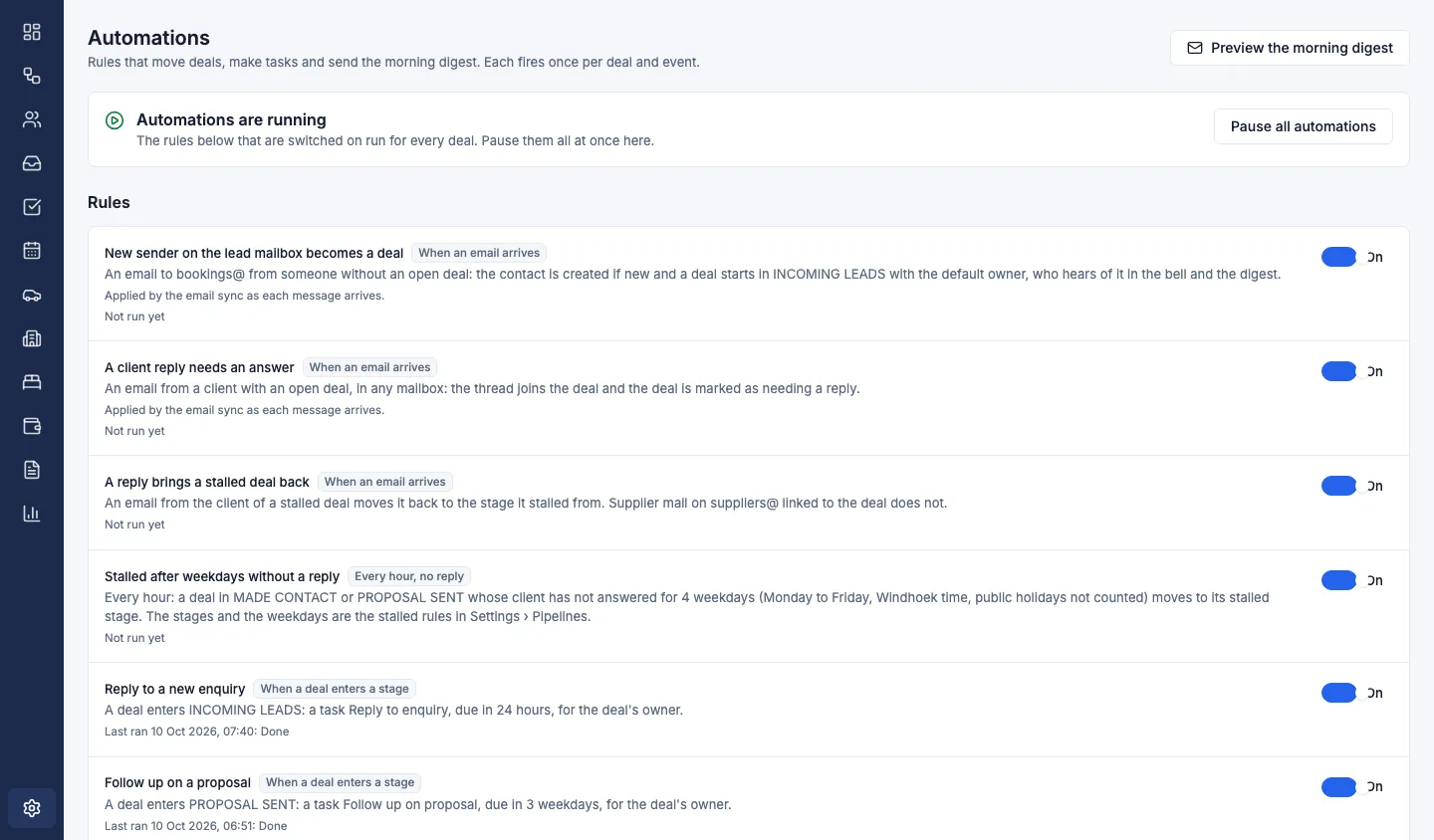
Rules can turn new emails into deals, flag replies, move stalled deals and create follow-up tasks. Read that list with a luxury client in mind. None of it sends a note in your name. It puts the work on your list. You decide whether a check-in is welcome, and you write it if it is.
A follow-up after a proposal is often better as a specific question than as a nudge. Asking whether they have looked at the harbour nights is a designer's question. A line that only says you are checking in is a queue clearing itself. The task can remind you that time has passed. The sentence should still sound like the person who planned the route.
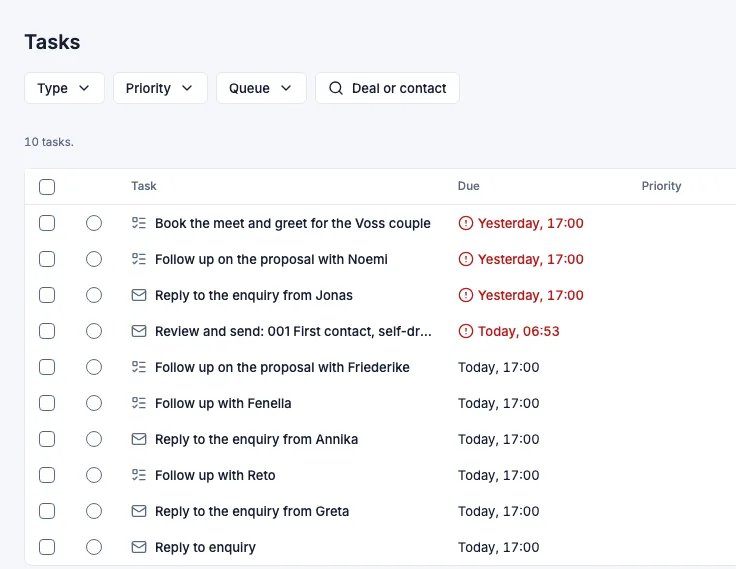
My day gathers today's follow-ups and replies, with the overdue ones in red. Red is a prompt to repair an accidental silence, which is different from manufacturing urgency. Some overdue items you will answer this morning. Some you will defer on purpose, because you know this family is away until Thursday. The judgement stays with you. The list stops the accidental ones.
If you add rules, add the ones that protect attention. A new enquiry becomes a deal so it is owned. A reply is flagged so it is seen. A stalled deal creates a task so it is a decision. Leave the writing alone.
A page they can read as if you were beside them
When the shape of the trip is ready, the client should not receive a spreadsheet with a polite covering note. They should be able to walk the journey: where they sleep, how long the drives are, what the days are for.
One click turns the costing into the client's own web page: a route map with drive times, lodge photos and a day-by-day story, in your brand. A PDF comes with it.
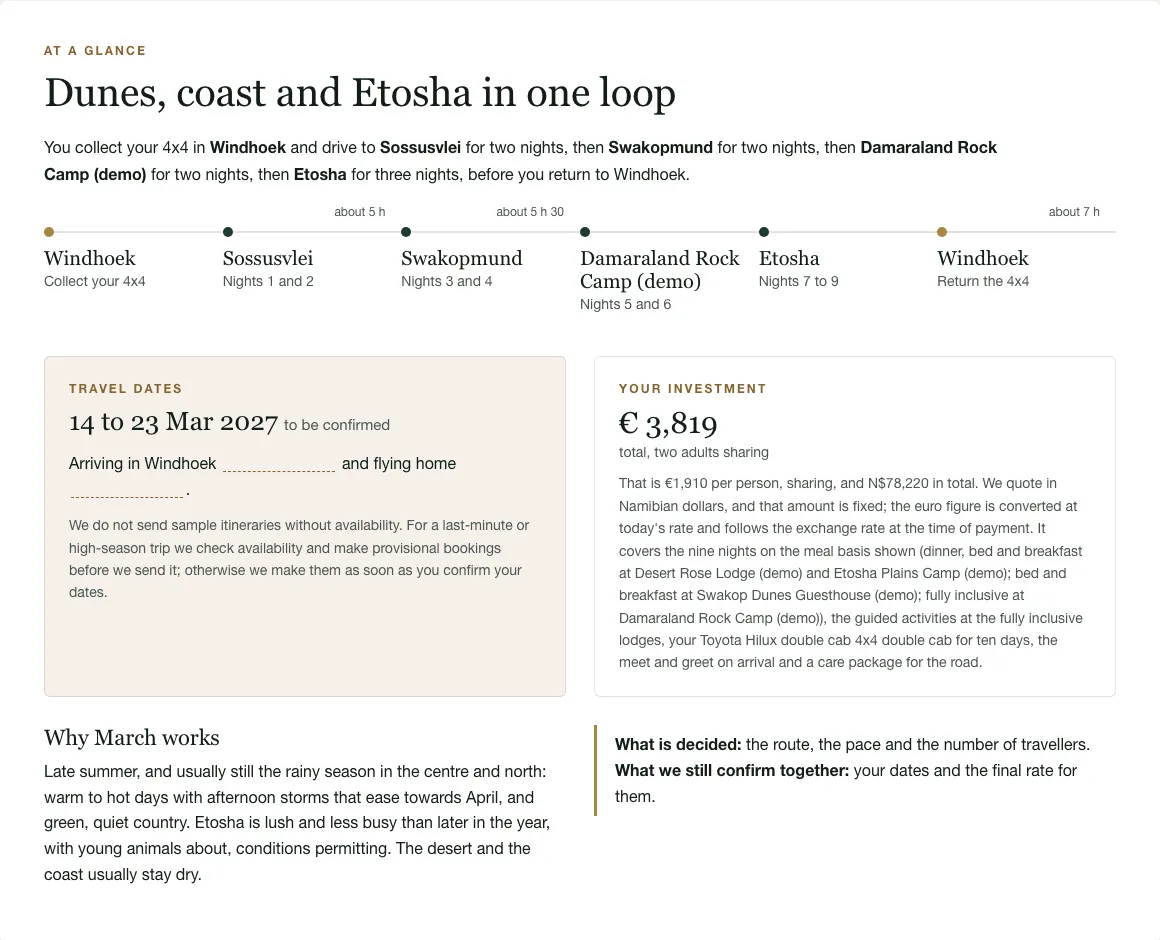
The route at a glance shows nights per stop, drive times, the travel dates and the price. Drive times between every stop matter more than designers sometimes admit. A couple who wanted a quiet villa rhythm will feel misled if a short hop is most of a day. Putting the time on the page is a form of honesty, and honesty is personal.
Lodge pages carry their own photos. Your logo and colours are on the proposal. On Pro and Max, clients never see Safari Studio on the page. On Lite, a small Powered by Safari Studio line remains. The point is the same either way: the document should feel like your studio's work, because it is. Branding also covers quotes, invoices and the client form, with your logo, colours and four theme presets, so later paperwork does not suddenly look like another company.
You can read more about proposals with a route map, drive times and lodge pages in your brand. Build the costing first, day by day, with your lodges, vehicles and activities at the rates you negotiated. Each amount is stored with the exchange rate of the day, so the margin stays right when rates move. Totals can be shown per adult and in other currencies, and a costing PDF is ready to send if someone else in the party asks for the working figures. The day-by-day costing is the private working copy.
For a mixed private journey, a yacht day, a villa stretch and a lodge night can sit in that one costing rather than in separate files. You are not using a marina system or a villa channel manager. You are keeping the plan, the money and the words in one deal.
Keeping promises when the trip has many keepers
A private journey is a set of promises made to people who cannot see each other's diaries. You tell the client a room is held until Friday. You tell a lodge you need two rooms. You tell your guide the vehicle is theirs from the tenth. Personal touch collapses if any of those promises lapse because nobody was watching the date.
Every room you ask a lodge for sits on the holds board: requested, held with an expiry date, confirmed or released. Hold requests go to each lodge from the deal. Before a hold runs out, a chaser email is ready to go, so nothing lapses quietly. Ready to go is the right standard. You still send it, in your voice, or you release the room and tell the client before they hear it from someone else.
The calendar puts meetings, safari dates, vehicle bookings, hold expiries and invoice due dates in one month. You can see that a hold expires the day before a call about the proposal. You can see that an invoice falls due while the client is on the water, and ask before they leave. Timing is a courtesy. Courtesy needs a calendar that knows the trip, not only your meetings.
When the journey includes a private vehicle, the fleet timeline shows every vehicle with its trips, services and blocked days. Assign a car to a trip and the clash shows before it happens.
Yachts and villas are often confirmed in correspondence, not on a vehicle row or a lodge hold. Keep that mail on the deal, and put the date you agreed onto the task list. A promise still needs an owner and an expiry, visible on a morning when you are tired.
Quotes made from the costing become deposit and balance invoices, in any currency, with a card payment button. Every payment is tracked against the deal. Late payments are grouped by how late they are, so a reminder can be specific. Send it in the same voice as the planning, from the person who knows the client.
A routine that does not flatten the studio
Software will not choose the right yacht, the right villa or the right camp. Taste stays with the designer. What a record can do is remove the small failures that make good taste look careless: the missed reply, the hold that died, the long drive nobody mentioned.
A practical way to begin:
- Sync the mailbox you already write from.
- Let website enquiries land on the deals board as new deals.
- Name stages in the words you already use, even if that is 'with the family'.
- Use needs reply flags before you add many rules. Rules should create tasks for you, not speeches for the client.
- Keep templates for signatures and lodge requests. Write the personal lines yourself.
- Read the proposal as the client will, including nights, drives and price.
Safari Studio is sold as a monthly, quarterly or yearly subscription, with a free trial and no card needed. Plans and prices are set out on their own page. The client should still feel attended to when the season is full, and when more than one designer touches the file.
If you want to see the board, the holds and a proposal in your brand, book a demo or start a free trial.