

A private journey does not start from a departure date on a brochure. It starts from a note: four travellers, a villa for the first three nights, then a camp, then perhaps a yacht day or a walking expedition, with dates that are still soft. The right luxury tour operator software has to hold that kind of trip, not a fixed product with a code.
Owners and travel designers know the pattern. The client changes the party. A lodge comes back with two rooms, not three. The vehicle you had in mind is in for service that week. The rate you quoted was in one currency and the supplier invoice arrives in another. None of this is a failure of planning. It is what bespoke work is. The question is whether the file can keep up.
This is a checklist for that file. It is for people who sell private journeys, villas, expedition camps and the occasional yacht leg, and who are tired of rebuilding the same trip across an inbox, a spreadsheet and a slide deck. Safari Studio is a CRM for safari operators, DMCs and the travel agents who sell their trips. What follows is what matters when every itinerary is built for one party, and which parts of the product are there to carry it.
When the itinerary has no standard shape
A group departure can live in a template. Same lodges, same vehicle, same activities, a new set of names. A private journey rarely works that way. The route is drawn for one party. The nights are negotiated one supplier at a time. A place you have not used before may be right for this brief, and wrong for the next.
That changes what you ask of the software. You are not checking seats on a set departure. You are assembling a trip that may not resemble any trip you have sold, then keeping every revision on the same deal. If the tool assumes a catalogue of tours, the real itinerary ends up beside it: in mail, in a sheet, in a document the client was sent last week.
Dates move, sometimes by a night, sometimes into another season. Villa changeover days, camp minimum stays and expedition start dates do not all flex together. A small shift can ripple through the route, the vehicle and the holds you have already asked for.
Party size changes too. A couple becomes a family, or a traveller drops out, and the figure per adult has to be rebuilt from the lines.
Suppliers answer on their own clocks. A hold can lapse while you are writing a different proposal. The design of the days and the diary date on a hold are the same job.
Money is rarely in one currency from the first estimate to the balance invoice. A camp, a vehicle, a guide and a villa may each be quoted differently. Copy those rates by hand between tools, and the total the client sees can part company from the total you meant.
The client expects a proposal that feels made for them. A pasted itinerary with a logo on the cover is easy to recognise, and on a private journey it sends the wrong signal.
If those pressures live in side files, the CRM is a contact list with a value typed in. The sections below are a way to test whether the system can be the file for the journey instead.
What luxury tour operator software should keep beside the trip
Start with the conversation. A bespoke trip is a thread of messages before it is a booking. Mail from every synced mailbox should sit in one list, and each thread should be linked to its client and its deal. The first brief, the revised dates, the note about a dinner, the question about a connecting flight: that is the memory of the journey. If it lives in one person's inbox, anyone covering the file is guessing.
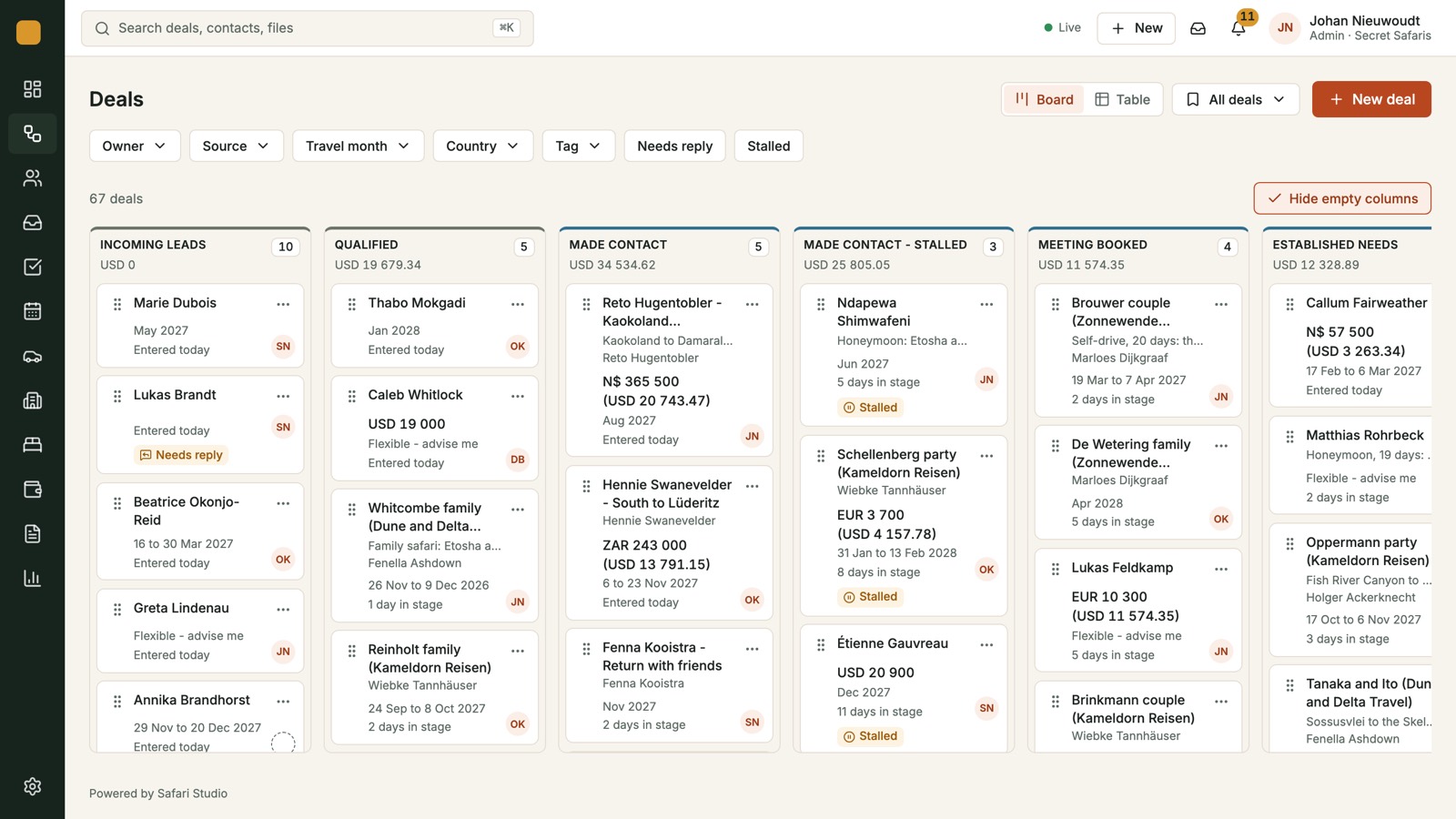
In the inbox and enquiries, Gmail syncs both ways, so a reply sent from Gmail still sits beside the trip. Any other mail provider can come in through a forwarding address. Needs reply flags mark what is still waiting, so a quiet client is not mistaken for an answered one. Website enquiries do not wait in a folder. They arrive on the deals board as new deals. Templates and signatures are set for every person and every mailbox, so the company's voice stays steady when more than one designer writes.
Private sales need stages you can name. On the deals board you drag deals through your own stages. Website enquiries land as new deals, with the email thread linked. Two-way Gmail sync keeps every reply beside the trip it belongs to. Stalled deals and unanswered mail are flagged. A deal can hold any currency, with its value at the day's rate. The card shows the client, the travel dates, the value in its own currency with the USD equivalent, and how many days the deal has sat in that stage.
A costing you can open again
Costing is built day by day with your lodges, vehicles and activities at the rates you negotiated. Each night, each transfer and each activity is a line, so a change touches what it should. Each amount is stored with the exchange rate of the day, so the margin stays right when rates move. You can read totals per adult and in other currencies, and send a costing PDF when someone needs the figures on a page.
A villa night or a small expedition camp is still a night you cost at the rate you agreed. The trip does not have to look like a standard departure for the file to hold it.
A page the client can walk
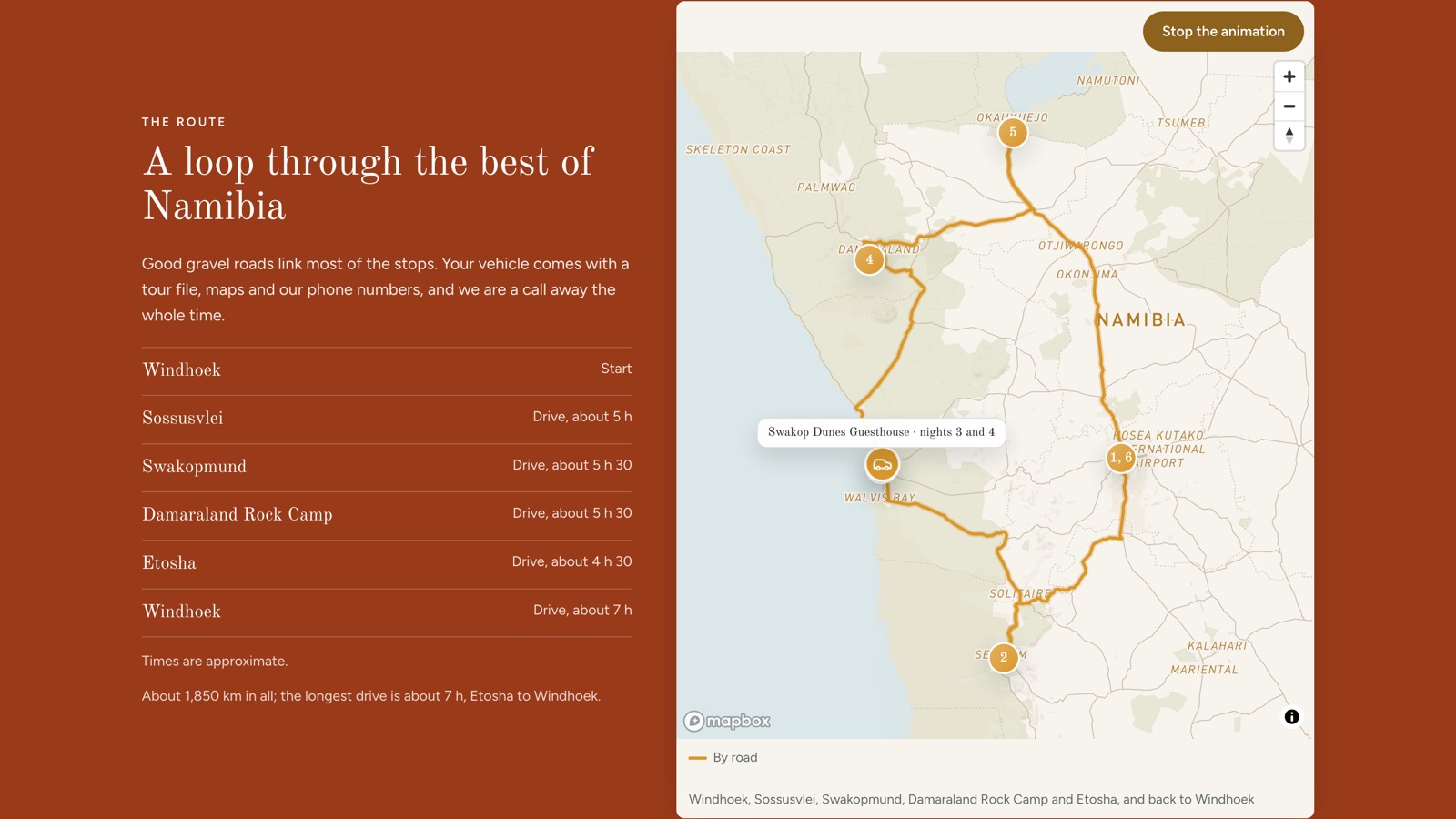
One click turns the costing into the client's own web page: a route map with drive times, lodge photos and a day-by-day story, in your brand. A PDF comes with it. Drive times between every stop matter on a private route, because the client is judging the shape of the days. Lodge pages carry their own photos. Proposals keep that page tied to the costing, so the story and the numbers are not two versions you must remember to align.
Your logo, colours and theme belong on the proposal, the quote, the invoice and the client form. Branding sets the logo, the colours and four theme presets. On Pro and Max, clients never see Safari Studio on those pages. Lite adds a small Powered by Safari Studio line. Plans are on the pricing page.
Holds, vehicles and money on the same file
A proposal can be ready while the rooms are not. It is a problem when a hold expires in a sent folder and nobody sees it until the client has already said yes.
Every room you ask a lodge for should sit where you can see it: requested, held with an expiry date, confirmed or released. On the holds board, requests go to each lodge from the deal. Before a hold runs out, a chaser email is ready, so nothing lapses quietly. A villa, a camp and a small expedition lodge will not share release rules. You need each expiry beside the trip, not a shared assumption about how long a hold lasts.
The vehicle is often part of the promise: one car for that party alone. Fleet puts every vehicle on one timeline with its trips, services and blocked days. Assign a car and the clash shows before it happens. One row per vehicle, trips as bars across the dates, services and blocked days on the same line. No 4x4 booked twice.
Quotes are made from the costing, then become deposit and balance invoices with a card payment button. Every payment is tracked against the deal. Invoices can be in any currency. You see what is owed and what is paid, and late payments are grouped by how late they are. There is no spreadsheet to keep in step. Quotes, invoices and payments stay on the deal you sold.
Those deadlines should meet. A meeting about the route, the safari dates, a vehicle booking, a hold expiry and an invoice due date are one trip. The calendar shows them in a single month.
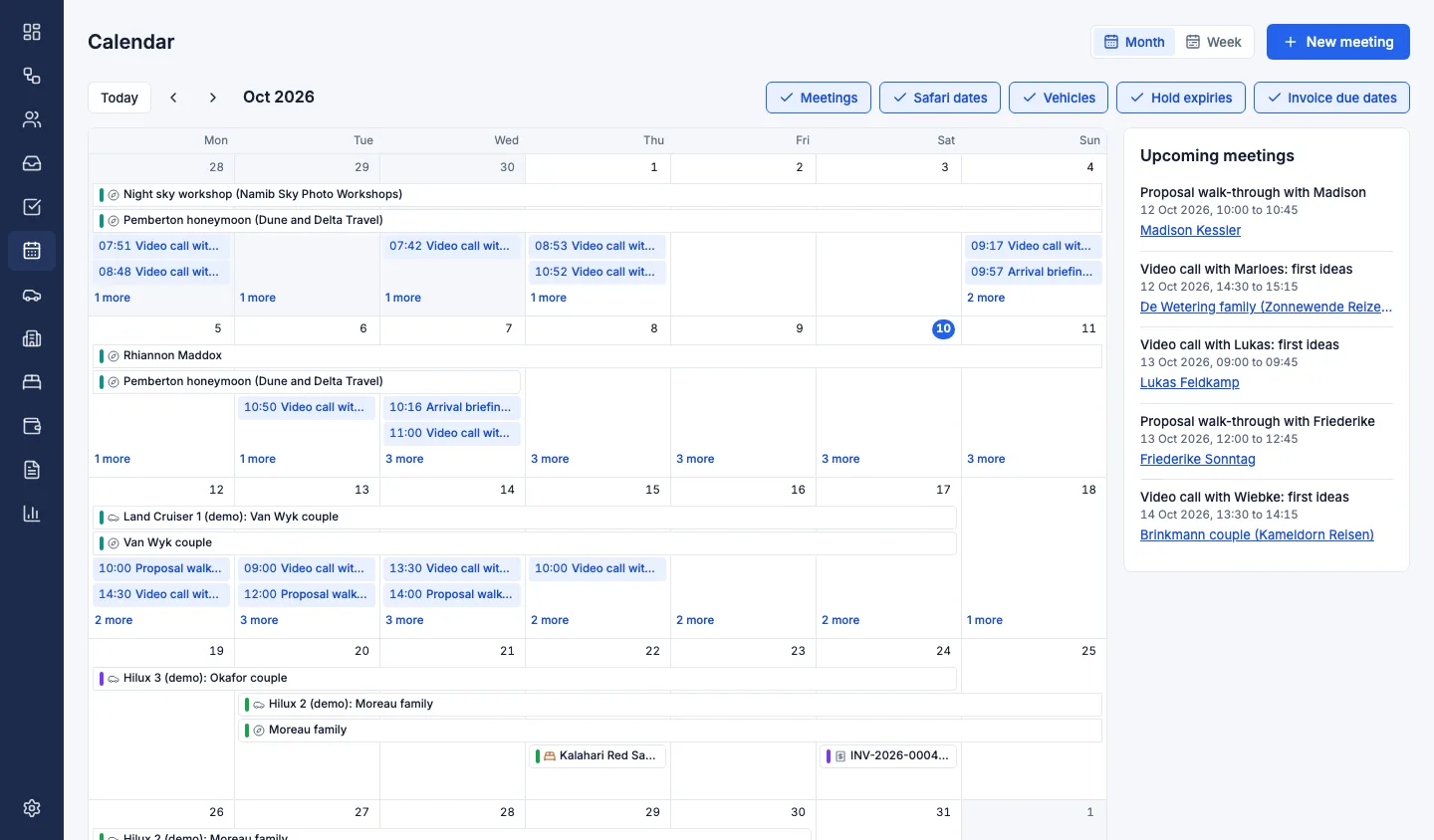
If those dates disagree, the proposal is ahead of the file.
A checklist you can use on a live trip
Use a journey you are planning now. A sample that never changes will hide the gaps. For example, a designer holding a villa, two camps and an exclusive vehicle will notice a missing expiry at once.
- Is every mailbox in one list, each thread linked to the client and the deal, with Gmail syncing both ways and other mail via a forwarding address?
- Do website enquiries arrive as deals, and can you see which messages still need a reply?
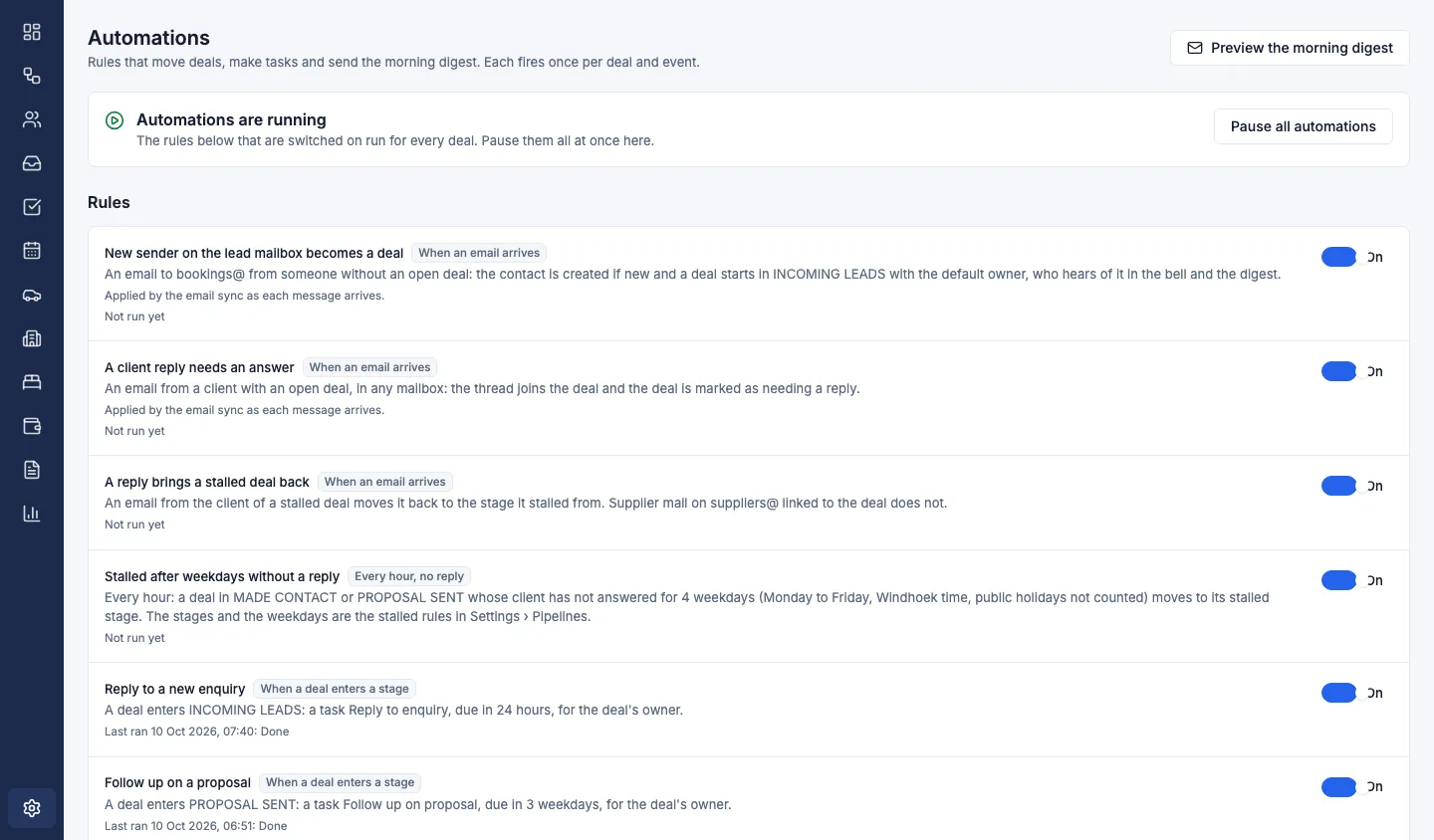
- Can you name your own stages, with stalled deals and unanswered mail flagged?
- Can a deal hold any currency at the day's rate?
- Can you cost day by day from negotiated lodge, vehicle and activity rates, each amount stored with that day's exchange rate, with totals per adult and a costing PDF?
- Does one click produce a branded web page and PDF, with drive times, lodge photos and a day-by-day story?
- Are your logo and colours on the proposal, quote, invoice and client form?
- Can you request holds from the deal, see each expiry, and send a chaser before a hold lapses?
- Does the fleet timeline show a clash before a 4x4 is booked twice?
- Are deposit and balance invoices made from the costing, with a card payment button, payments tracked on the deal, and late amounts grouped by how late they are?
If several answers are no, the journey is still being run outside the system. The same questions suit a DMC building a private programme for an agent, and an agent shaping a trip for one party. See how the parts fit on the features for planning and selling a trip.
What should stay with the designer
Software does not choose the villa, the yacht day or the weight of an expedition. That judgement is what the client is buying. The file's job is custody: keeping the thread, the stages, the costing, the holds, the fleet and the invoices on the deal, so a good decision is not undone by a missed expiry or a retyped total.
Safari Studio is sold monthly, quarterly or yearly, with a free trial and no card needed.
If the thread, the costing, the holds and the invoice can live on one deal, the system matches the work. To see it on your own trips, book a demo or start a free trial.