

Costing a trip that moves between several lodges is a stack of decisions, not a single cell. Safari costing is the work of putting supplier rates, park fees, vehicles and activities on the days they belong to, then reading a margin you can still explain after the exchange rate moves.
If you handle reservations for a safari operator or a DMC, you have probably done this in a spreadsheet. A tab per trip. Rates pasted from a contract. A park fee last touched last season. A margin formula that assumes one currency. Spreadsheets are flexible, which is why they became the default. They are also where totals drift, once the trip has three lodges, a season break, and a client who wants the price per adult in their own currency.
This is for owners, reservations managers and consultants who price those trips. It stays with the costing: day by day lines, negotiated rates, park fees as their own amounts, and a margin that does not rewrite itself when rates move.
Why safari costing outgrows a spreadsheet
A spreadsheet will hold almost anything. That is its strength and its limit. Nothing in the file knows that night three is a shoulder-season rate and night four is high season, unless you typed a note. Nothing stops a colleague overwriting the exchange rate at the top and changing every quote that still points at that cell.
On a short stay you can hold that in your head. On a multi-lodge safari you cannot. Lodges invoice in different currencies. One includes activities, the next charges each game drive. A vehicle may be yours on the driving days and a supplier's on the transfer. Fees change when the party enters a new reserve, and sometimes when they cross a border.
Copying last month's file feels like a repair. Names change, one lodge is swapped, and an old child rate sits unseen. The margin looked fine until a single supplement was added and the formula was not extended. The costing has to remember which rate applied to which day, and which exchange rate was in force when you priced it.
What a day by day costing has to hold
Price the trip as a sequence of days. Each day should answer four questions.
Where do they sleep, and at which rate? The lodge, the room, the meal plan and the contracted rate for those dates. If the stay crosses a season change, use two lines, not an average.
How do they move? A full vehicle day, an airport transfer and a light aircraft hop are different costs. Yours may be an internal figure. A supplier's is their rate for that day.
What is not already in the lodge rate? A walk, a mokoro, a night drive sold separately, a community visit. Some camps include these. Some do not. Follow the contract for this stay, not the habit of the last one.
What else is due? Park and concession fees, conservation or community levies, a guide allowance, a picnic, visa support if you include it, drinks if you have chosen to. Easy to leave in a footnote. Easy to underprice.
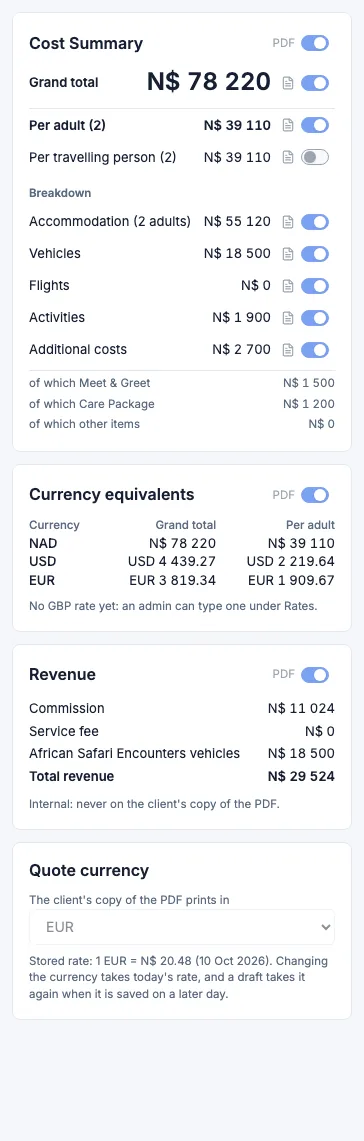
Day by day costing for lodges, vehicles and activities keeps those lines at the rates you negotiated. The summary splits accommodation, vehicles, activities and additional costs, with a total per adult and a grand total.
Clients expect accommodation to dominate. On a small group, vehicles and additional costs can be a large share of what you pay. If those lines are buried, the margin is a guess.
Supplier rates, on the day they apply
A lodge rate is a season, a room type, an occupancy and often a meal plan. Use the rate you negotiated. Not a rack rate from a website. Not last year's figure, carried forward because the new contract is still in an inbox.
For example, a reservations manager pricing six nights for a couple might have a camp on a contracted net rate, a second lodge that enters high season on night four, and a single supplement if one traveller takes their own room. Each of those belongs on the night it applies to.
Season dates rarely match a client's week. If you average two rates you may be close on a short stay and wrong on a longer one, and you cannot show the lodge why your expected invoice differs from theirs. Child rates and extra beds work the same way. A reminder to check is not a line.
Keep the supplier's currency as quoted. Convert for the client view, but do not throw away the original. You will need it when the proforma arrives, and when you explain a change.
Park fees, vehicles and the lines beside the lodge
Park fees are often folded into something else. They should stand alone. They are not a lodge rate, and they are not always an activity.
They may be per person, sometimes different for a child or a resident, and per vehicle. A reserve may add a conservation or community fee per night. A walking or boat permit may sit on top of entry.
A multi-lodge trip often crosses more than one of these. For example, a lodge operator in the Okavango who then sends guests into a national park, or a DMC crossing a border, is not pricing one fee. One cell copied from the last quote is how a margin thins out, without anyone choosing to discount.
Put the amounts on the days they fall due, as activities or additional costs, so the breakdown shows them. If additional costs are larger than you expected, check fees before the deposit is paid.
Vehicles need the same honesty. A self-drive day, a guided day and a transfer are not interchangeable. If the vehicles are yours, the fleet timeline shows each one with its trips, services and blocked days, and a clash shows before a car is booked twice. A substitute you have not priced means the costing is not finished.
Holds are the other soft point. On the holds board, every room you ask a lodge for is requested, held with an expiry, confirmed or released. A chaser email is ready before a hold runs out, so a costed rate does not lapse quietly and come back higher.
Exchange rates, and a margin that stays put
Rates arrive in more than one currency. A lodge may quote in US dollars, a vehicle supplier in Namibian dollars or rand, a client in pounds or euros.
One exchange rate at the top of a sheet is easy to change, and that is the problem. Change it and old quotes move. Leave it and new trips use a stale rate. The margin on the screen is then not the margin you will earn.
Each amount in the costing is stored with the exchange rate of the day. Tuesday's price keeps Tuesday's rate. Next week's trip uses its own day. When the market moves, sent costings do not rewrite themselves. You can still show totals in other currencies without reopening a quote that has already gone.
The margin is what remains after lodges, vehicles, activities and additional costs, at the negotiated rates and the stored exchange rates. It has to cover the work of building and confirming the trip, and the risk that a fee was missed.
A markup added on top of cost is not a margin kept from the selling price. Mix the two up and you overstate what remains. You do not need a percentage borrowed from another firm. Look at the gap in money before the price goes out.
Per adult figures are the second reading. Clients compare per person. You buy some items per room or per vehicle, so two travellers make a vehicle day heavier per adult than four do. A comfortable grand total can hide that. Read both before you agree a discount.
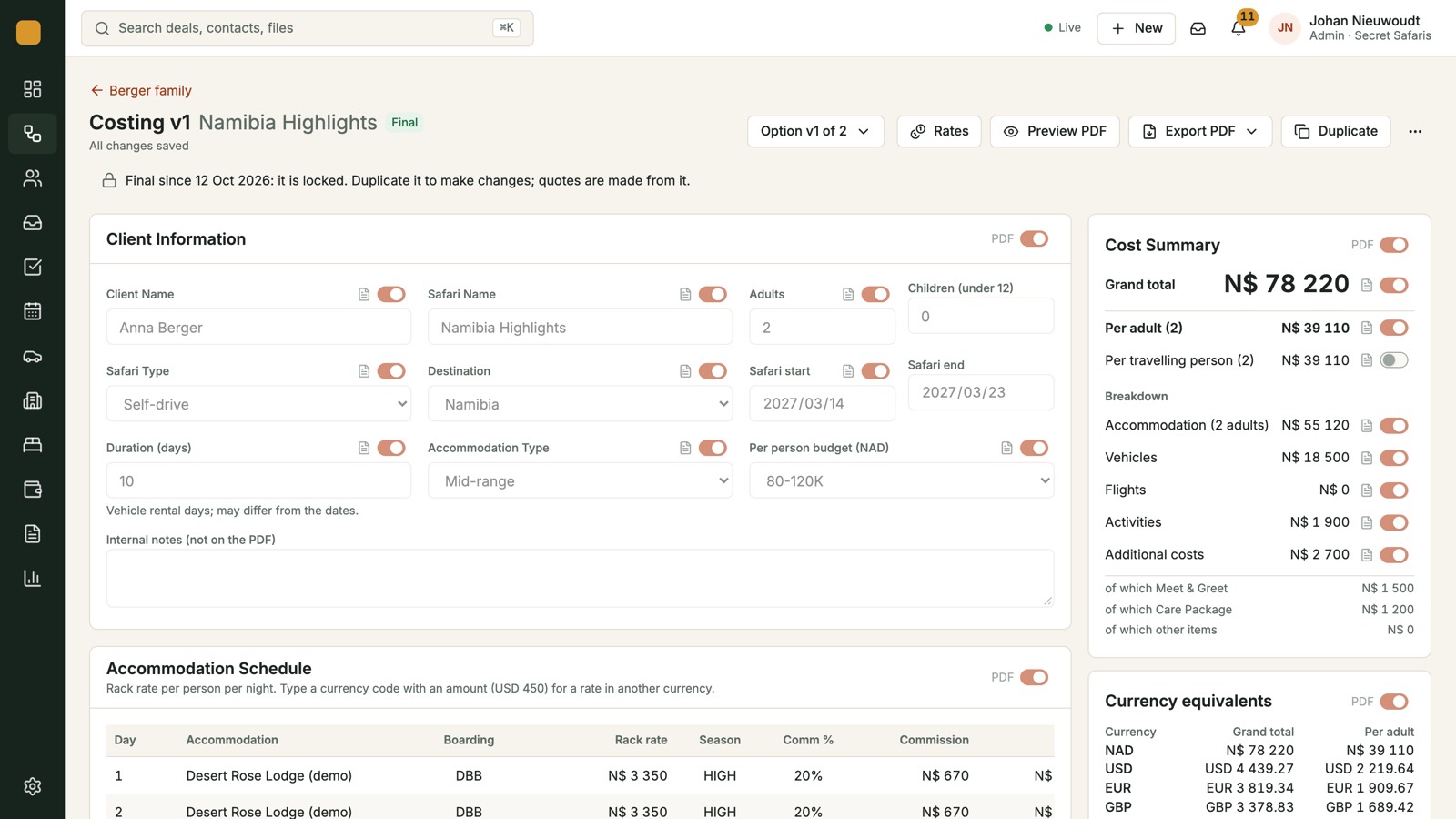
The screen shows that split for a costing labelled the Berger family: grand total, per adult amounts, and accommodation, vehicles, activities and additional costs. If one share looks wrong, open the days and find the line. A costing PDF is ready from the same screen, so what you send is what you checked.
From the costing to the quote
Quotes are made from the costing, then become deposit and balance invoices in any currency, with a card payment button. Payments are tracked against the deal, so you can see what is owed and what is paid without a second spreadsheet. Late payments are grouped by how late they are. See quotes, invoices and payments.
The same costing becomes the client's own web page in one click: a route map with drive times, lodge photos and a day by day story, in your brand, with a PDF as well. Your logo and colours are on the proposal. On Pro and Max, clients do not see Safari Studio on it. More is on proposals and route maps.
What to check before the price goes out
Fix the line that fails. Do not patch the total, or the next change inherits the error.
- Every night carries the negotiated rate for that date, including a season break, a single supplement or a child rate where it applies.
- Vehicles and transfers sit only on the days they are used, and a vehicle you do not have is not assumed.
- Park fees, levies and permits are their own lines, under activities or additional costs, for each park the party enters.
- Amounts still show the supplier's currency, with the exchange rate of the day stored beside them.
- The grand total and the per adult total both make sense for this group.
- The margin is a gap you have looked at in money, not a leftover percentage from another trip.
- Holds the price depends on are still alive, or you have treated that line as not yet firm.
- The PDF or the quote is generated from this costing, not typed again beside it.
Start with the next trip
You do not need to rebuild every rate card before you begin. Take the next trip with more than one lodge. Enter the days, the negotiated rates, the park fees and the vehicle lines. Read the per adult figure and the margin. Send the costing PDF from that screen. A spreadsheet can stay as a scratch pad while a rate is still being agreed. It does not have to hold the client's price.
Safari Studio is a CRM for safari operators, DMCs and the travel agents who sell their trips. It is sold as a monthly, quarterly or yearly subscription, with a free trial and no card needed. Plans and prices are on the pricing page.
If you want to walk a familiar multi-lodge itinerary through the costing, book a demo. If you would rather try it on a live enquiry, start a free trial. Bring more than one lodge, a park fee and at least two currencies. That is the trip a spreadsheet finds hardest, and the one worth testing first.