

An enquiry lands in the shared mailbox before the office is fully at the desk. Someone forwards it. Someone else replies from their own account. Later, nobody can say with confidence who answered last, or whether the client is still waiting. That pattern is familiar at safari operators and DMCs across Africa, and it is the practical problem safari enquiry management has to solve: keeping the latest reply and the owner of each enquiry in view.
This guide is for owners, reservations managers and consultants who still receive enquiries by email and then pass them around the office. It does not ask you to abandon email. Clients, agents and lodge partners already know your address. The change is to stop treating a forward as a way to assign work, and to stop treating one person's sent folder as the record of what was promised.
Safari enquiry management when the office forwards mail
Most operators did not choose a shared mailbox as a system. It grew. A camp, a mobile operator or a DMC sets up one address and asks agents, direct clients and partners to write there. Several people can open it. On a quiet week, that is enough. On a week of new trip requests, date changes and lodge correspondence, the same inbox becomes a queue with no named owner.
The forward feels like the helpful move. A consultant sees a request that suits a colleague and sends it on, often with a short line asking them to take it. Sometimes the shared address stays on copy. Often it does not, because a reply is quicker from a personal account, between calls, or from a phone while someone is away from the desk.
Then three things split apart. The latest reply lives in one mailbox. The shared box still shows the first message, or an older forward, so anyone else who opens it cannot see what was offered. The owner is implied by the forward, not recorded on the enquiry. If that person is with guests, on the road between camps, or simply off for the afternoon, the enquiry has no visible home. The client knows none of this. They wrote once, and they are waiting.
For example, a lodge operator in the Okavango might receive a direct enquiry and a travel agent enquiry on the same morning. Both mention dates, a party size and a route. One is forwarded to the person who costs the water. The other goes to the person who speaks to agents. By evening the shared mailbox can show two threads that look untouched, while the real conversation has moved.
A DMC sees the same split. An agent writes to the general address. A consultant forwards it to a colleague, who answers from their own account. The agent replies with a change of dates, and that reply never returns to the shared box. Asking where things stand then means a search through sent mail, or a question in the corridor.
The person covering the desk cannot repair that from the shared address alone. They can see that a message arrived. They cannot see, without asking, whether a reply already went out from a phone, which date was discussed, or who is expected to write next. The client, meanwhile, has one thread in their own mail, and no idea that the office is looking at an older copy.
What slips when several people share one address
An enquiry is a small set of facts the office will need again: who wrote, which mailbox it arrived in, what they asked for, who is handling it, and whether anyone has replied. A shared mailbox stores the arrival. It is weak on the rest, once people start answering from somewhere else.
The owner slips first. If two consultants both think the other has taken a forward, nobody has. If both answer, the client receives two versions of the trip. Neither person meant to cause that. There was no shared signal of ownership.
The latest reply slips next. One person replies to everyone. Another replies only to the client. A third pastes part of the history into a new message with a clearer subject. The shared mailbox holds a fragment. The promise that matters sits in a mailbox the rest of the team does not open.
An unread count will not save you. Unread can mean a rate sheet, a newsletter, or a message opened on a phone and left. The desk needs a mark that means this client is waiting, not merely that something new arrived.
The trip slips last. Dates, party size and a budget in a given currency are easy to lose when the only copy is a shortened forward. For example, a DMC consultant might remember the party and forget that the agent had already asked to drop a camp. The full thread had that. The forward did not.
At the end of a morning, ask four questions of what is sitting in the shared mailbox:
* Who owns this one? * Where is the latest reply? * Is the client waiting? * Which trip does it belong to?
If you cannot answer from the screen in front of you, the mailbox is receiving work. It is not holding it. That test is worth doing before you add another address, another folder, or another person to the copy line. More people on copy does not restore a forked thread. It only adds more places where a later reply might hide.
One inbox, the latest reply, and a named owner
The useful change is modest. Mail from every synced mailbox sits in one list, and each thread is linked to its client and its deal. People still write email. The office sees one conversation, including the reply that went out this morning, not an earlier forward.
Gmail syncs both ways. If reservations is on Gmail, a reply written in Safari Studio and a reply written in Gmail stay on the same thread. For any other mail provider, a forwarding address brings the mail into that same list. Agents keep the address they already use. You stop using an internal forward as the only way for a colleague to see the latest reply.
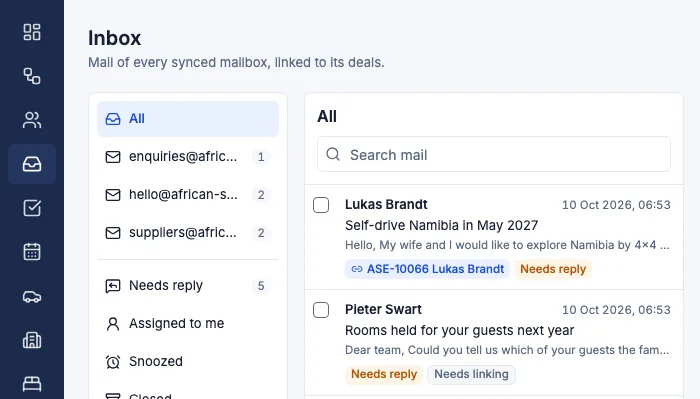
Needs reply replaces the guesswork of an unread count. A client who has written, and has not yet had an answer, stays marked. Supplier mail does not look like a waiting family. No client waits unseen because their message was forwarded into a corner of the office.
Email templates and signatures are set for every person and every mailbox. The client still gets a note in the consultant's voice, with that person's signature, from the mailbox they wrote to. Templates hold repeated lines, such as how you ask for dates and who is travelling. The knowledge stays with the person. The thread stays with the office.
The detail, including two-way Gmail sync and a forwarding address for other mail, is on the inbox that links each enquiry to its deal.
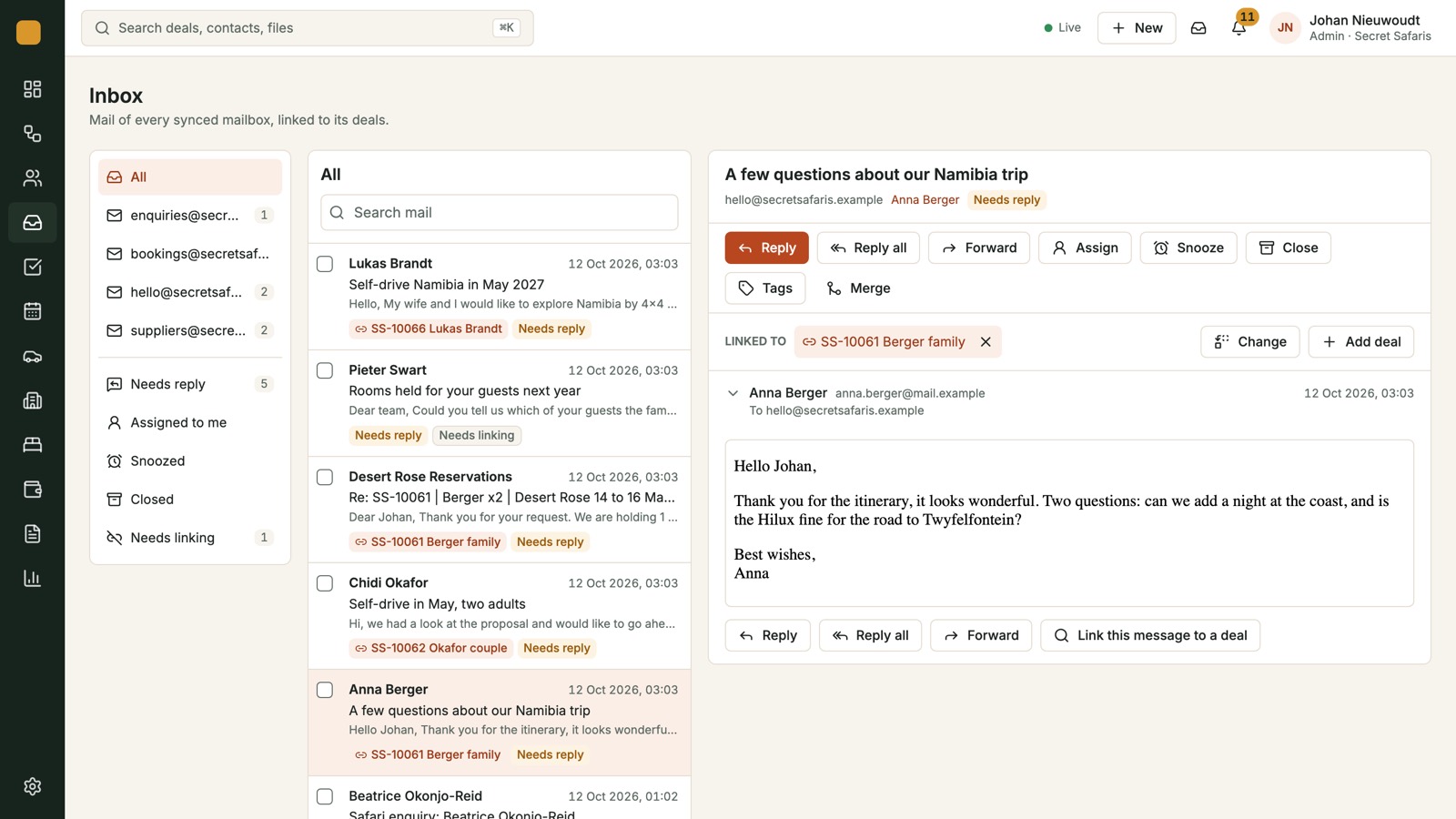
Reply, assign and snooze sit on the enquiry. Reply keeps the answer on the thread the desk can open. Assign names the owner, so taking a mail is a fact on the enquiry, not a sentence lost in someone else's account. Snooze sits beside reply and assign.
One person owns the enquiry. Others can still read the latest reply, because the thread has not left the list. If the owner is out with guests, a colleague opens the same enquiry and sees what was last said, instead of rebuilding it from forwarded copies.
Ownership here is practical. It does not mean a second person may not help with a lodge question or a vehicle. It means the desk can point to a name when someone asks who has the agent waiting on a departure. The name sits with the thread. It does not live in a memory of who was copied on the first forward.
From the inbox onto the deals board
A form on the website often lands in the same busy address, or in a folder someone checks when they remember. On a morning of lodge mail, that folder waits.
Website enquiries arrive on the deals board as new deals, with the email thread linked, so nothing waits in a folder. Drag deals through stages you name yourself. Stalled deals and unanswered mail are flagged. Value can sit in any currency, at the day's rate, when a direct enquiry and an agent enquiry do not share a currency. See the deals board, where the website form creates the deal.
A forward cannot make this join. Open the deal and the thread is there, with the latest reply and an owner. Two-way Gmail sync keeps the next reply beside the same trip, so a second consultant does not answer it as if it were new. When the enquiry is real, cost it day by day on the costing for lodges, vehicles and activities.
That order matters. A careful costing cannot repair an enquiry nobody owned. The rates, the party and the dates have to be read from the current thread, not from a forward that stopped halfway through the agent's questions. Once the deal holds that thread, the person who costs the trip and the person who wrote the reply are looking at the same story.
A routine the reservations desk can keep
The morning check stays. What changes is that the check has one screen.
* Start with the one list. Mail from synced mailboxes, and mail brought in by a forwarding address, is already together. * Assign an owner before you move on. Reply on the thread if it is yours. If it is a colleague's, assign it and leave the thread in the list. * Use your own signature. Templates cover the lines you repeat, so the answer can still sound like the person who knows the trip. * Before you leave, look at needs reply. It is not a target time. It is who is waiting. Answer, or name the person who will.
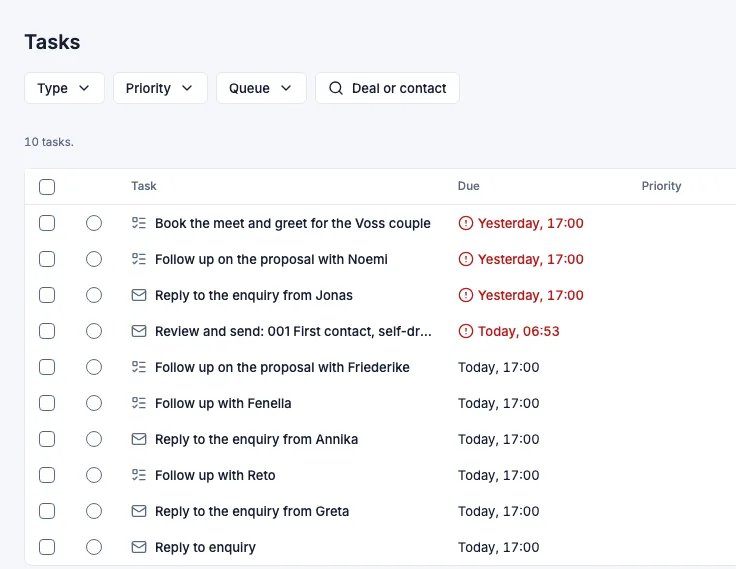
My day shows today's follow-ups and replies, with the overdue ones in red. Use it for the afternoon pass. An owner can open the same view, see the name on each enquiry, and read the latest reply without asking for a written status.
Reservations managers can run this without calling a meeting. If the list has an owner and the thread has a latest reply, the enquiry is in hand. If either is missing, that is the one to fix before anyone leaves the desk. Consultants do not need a new folder path explained each Monday. They need the same four moves: open the list, assign, reply on the thread, and check who is still waiting.
When you cover a colleague, open the enquiry and read the latest reply before you write. For example, a consultant covering at a DMC should see that an agent asked for a date change, and that nobody has answered, without calling someone on the road.
What to keep, and what to stop
Keep the address clients and agents already use. The person who knows the trip still writes the answer, in their own voice, on a thread the office can read.
Stop the habits that hide work:
* Do not use a forward as the assignment. Assign the owner and leave the thread visible. * Do not reply from a mailbox the team cannot see, unless the reply stays on the thread. Two-way Gmail sync keeps a Gmail reply with that thread. Any other provider can use a forwarding address. * Do not treat unread as care. Needs reply is the mark that matters. Clear it by answering or assigning. * Do not leave website enquiries in a side folder. They arrive as deals. Assign them with the morning mail.
For the first week, connect the mailboxes you actually answer and judge the day with three questions. Is every new enquiry assigned? Is every waiting client answered, or still marked? Can a second person read the latest reply without asking?
You do not need every old thread filed before those questions can be answered. New enquiries are the ones that slip. Sync the Gmail address you reply from, or forward the other address into the same list, and treat the next enquiry as the start. If the three answers are yes by the end of the week, the shared mailbox is a front door again. It is no longer the place a client waits while the office searches sent mail.
Safari Studio is sold as a monthly, quarterly or yearly subscription, with a free trial and no card needed. Read the plans on the pricing page.
Safari enquiry management is a way to see who owns each enquiry, and what was last said. Keep the address your clients know. Name an owner. Leave the latest reply where a colleague can find it.
If you want to see that inbox against the mail your office already receives, book a demo or start a free trial.