

A guest who has written to more than one company will not wait out of loyalty, and safari enquiry response time is often what decides who gets to plan the trip. The route, the lodges and the price still have to be right. None of them is heard if the first answer arrives after the client has started with someone else.
This is not an argument for a rushed note that says nothing. Reservations work across Africa runs into real limits: lodge space, vehicle calendars, park dates, and clients writing from other time zones. A fast reply only helps when it is clear enough to move the conversation on. The aim is a first answer sent while the enquiry is still warm, from a desk that can see which threads still need a person.
Owners feel a slow desk as bookings that never start. Reservations managers feel it as a queue hiding in personal mail. Consultants feel it as pressure to sound personal while the unread list grows. Those three can sit together when the path from enquiry to reply is short, shared and obvious.
Why safari enquiry response time shapes the booking
When a traveller, or the agent booking for them, sends an enquiry, they are usually comparing. They may have written to you and to other operators the same afternoon. They are not running a formal tender. They are looking for a sign that someone competent has read the note.
A prompt reply does three quiet jobs. It confirms the dates and the party, so you do not cost the wrong trip. It asks for the one or two facts you still need, such as lodge style or a budget range. And it shows that a person is on the other end.
A late reply does the opposite. The client fills the silence. They shape flights around a different plan. They accept space elsewhere. By the time a careful proposal arrives, the decision has often moved, even when your itinerary would have suited them better.
You do not have to promise rooms you have not checked. A good first reply can be short. Thank them. Repeat the dates and the number of travellers. Say what you are checking. Name the day the fuller answer will come. That message only works if it leaves while the enquiry is fresh, and if someone owns the follow-up.
For example, a DMC that receives a Friday request for a family of four in July, mixing a mobile camp with a fixed lodge, can still answer before the weekend. Dates noted. Two styles of camp to confirm on Monday. One question about how the children like to sleep. The company that opens the same mail on Tuesday is joining a conversation that may already have a favourite.
Where the hours disappear
Most delays are not a lack of care. They are gaps between the client's send button and a named person with the context in front of them.
Mail is split. The website shows one address. The owner still works from a personal inbox. Reservations sits on an alias only two people can open. A consultant on leave takes unanswered threads with them. A colleague cannot see what was already said, so they either send a second reply or wait and hope.
Website enquiries sit apart from the pipeline. The form produces an email. Someone copies names and dates into a sheet. The original message stays in a folder. When the client writes back, that reply is not beside the deal. The consultant hunts through subjects and hopes the latest thread is the right one.
Read and unread are weak signals. A thread can be opened, discussed in the office, and still have no answer. Unread can be a newsletter or a lodge tariff. The queue you actually need is narrower: client mail that expects a response, and deals that have gone quiet while everyone assumed someone else had replied.
Templates are missing, or so stiff that people will not use them. Without a starting point, every holding note is typed from scratch between calls to camps.
The form can slow you down as well. Ask for too little and the first reply is only a request for basic facts. Ask for a long story, then leave the answers in an inbox, and the detail never becomes a deal with an owner.
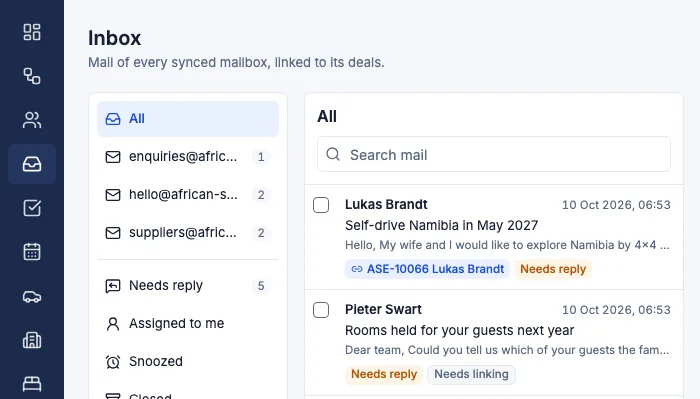
Safari Studio is a CRM for safari operators, DMCs and the travel agents who sell their trips. On this path, mail from every synced mailbox sits in one list, and each thread is linked to its client and deal. Website enquiries arrive as new deals, so nothing waits in a folder. Gmail syncs both ways. Any other mail provider can come in through a forwarding address.
Needs reply flags on a shared inbox
A shared list is only half of the job. You still need a mark that says this thread is waiting on you, not on the client and not on a lodge.
Needs reply flags are that mark. In the shared inbox, where every synced mailbox sits in one list, each enquiry is linked to its deal and marked when it needs a reply. A consultant back from a camp visit, or from the school run, does not rebuild the afternoon from memory. The flag is the queue.
Stalled deals and unanswered mail are flagged on the deals board as well. A deal can look healthy because it has a stage and a value, while the last client email has been sitting. The flag pulls that deal back into view before the quiet becomes a lost trip.
Shared flags matter when more than one person touches a file. The consultant drafts. The reservations manager checks a camp. The owner looks in on trips that need a decision. The mark tells the next person the client is still waiting. That is more reliable than a comment in the corridor.
For example, a lodge operator in the Okavango might have three people on mail in high season: one at the property, one in town, and one covering the evening. Without a shared flag, each assumes another has answered the couple who asked about a week in August. With the flag, the evening cover can see the thread is still open and send a holding reply before the client's morning starts.
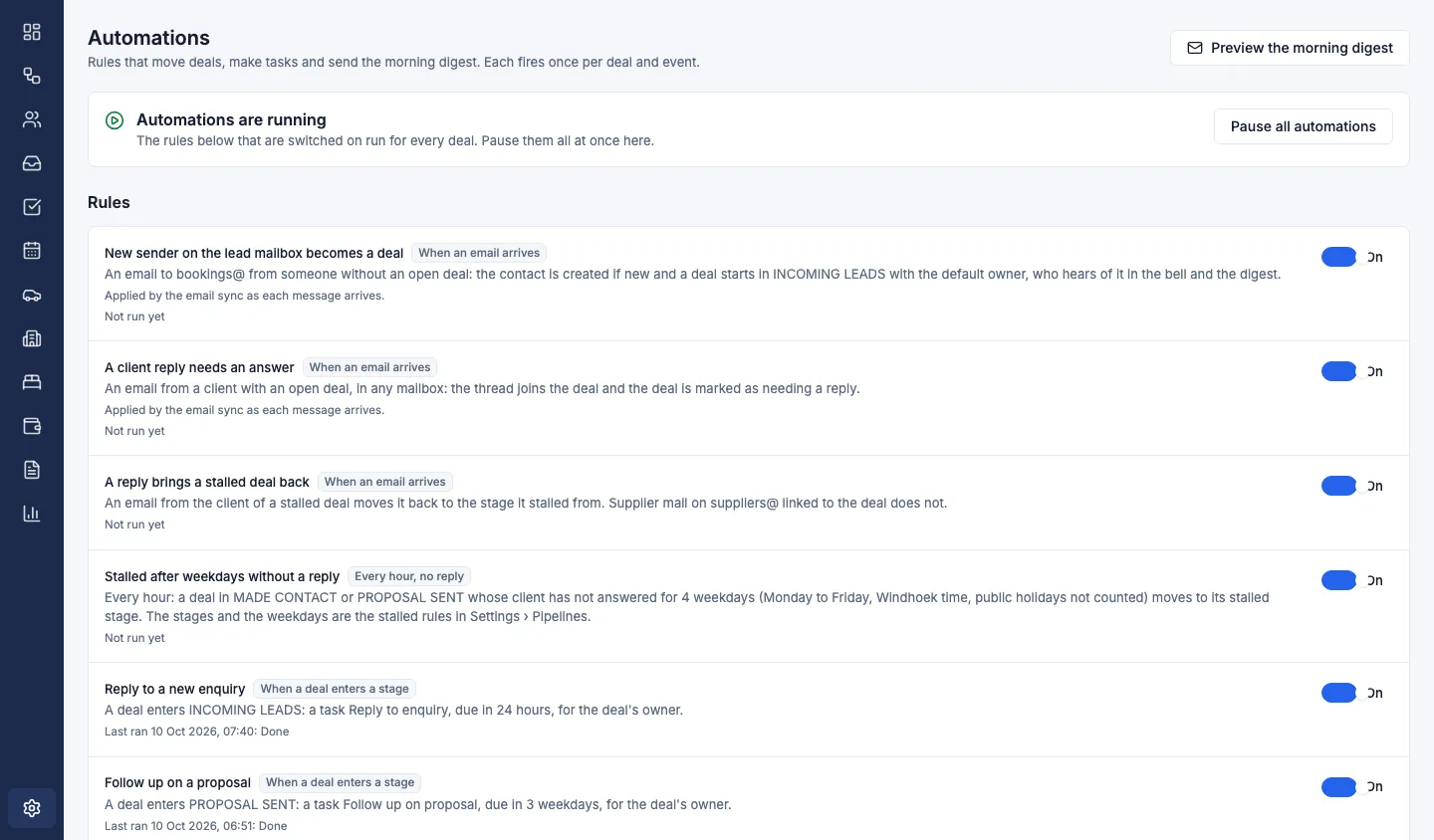
Rules can carry the admin around that habit. They can turn new emails into deals, flag replies, move stalled deals and create follow-up tasks. The rule remembers. The person still chooses the words.
Templates that save typing, not judgement
Email templates and signatures are kept for every person and every mailbox. That split is practical. Someone covering a shared reservations address can send with the company signature. The same person, writing to an agent they know, can use their own name and their own sign-off. The client sees one company, and still sees who is looking after the trip.
A template is the part you would type every time. It is not a script you must send unchanged. A first reply usually needs:
- A thank you that names the trip in plain words, not only a reference code
- The dates and the number of travellers, repeated so mistakes show early
- One or two questions you truly need, not a second application form
- A next step, and the day they will hear from you
- Your name, your role and a phone number that is answered
Leave out a price you have not costed, a promise of named rooms, and a long company history.
Keep a second template for the note that follows a lodge check: what you can offer, what you cannot, and when the full proposal will be ready. Write the itinerary for that client. When the costing is done, one click turns it into the client's own web page: a route map with drive times, lodge photos and a day-by-day story, in your brand, with a PDF alongside. That page is the full answer. The first email only has to earn the right to send it. See how proposals carry your route, lodges and brand.
Let the enquiry form feed the board
The website enquiry form should feed the board, not a side folder. A submission arrives as a new deal, with the email thread linked. From there you drag deals through your own stages. Two-way Gmail sync keeps every later reply beside the trip it belongs to.
Treat the form as a reservations tool. Each field should remove a round of email, or it should not be there.
Ask for:
- Travel dates, or a month if the dates can move
- Adults and children, with ages where camp rules need them
- Where the trip should start, if that changes the routing
- A budget range, in the currency the client thinks in
- How they hope to travel, or a note that they are not sure
- A few lines in their own words
Skip passport numbers and final rooming lists. Those belong once the trip is real. You need enough to open a deal someone can answer today.
Any currency can sit on the deal, with its value at the day's rate. You can acknowledge a dollar, pound or euro range in the first reply, then build the costing day by day with the lodges, vehicles and activities at the rates you negotiated. Each amount is stored with the exchange rate of the day, so the margin stays right when rates move. The costing PDF can follow. The first reply should not wait for it. The steps for that build are on the day by day costing page.
A rhythm the desk can keep
Flags and templates do nothing if the day has no rhythm. Open what needs a reply before other mail. Send a holding answer for anything that arrived overnight and cannot be fully costed yet. If a deal is waiting on a lodge, move it to the stage that says so.
Look again later in the day. High season does not arrive in one batch. A needs reply mark from the morning should not still be open in the afternoon, unless someone is writing the answer now.
Before you stop, leave the queue visible to the next person. If you are the last one online, a holding reply is better than silence. Create the follow-up while the promise is fresh. Lodge options on Tuesday is a task, not something to remember in the car park.
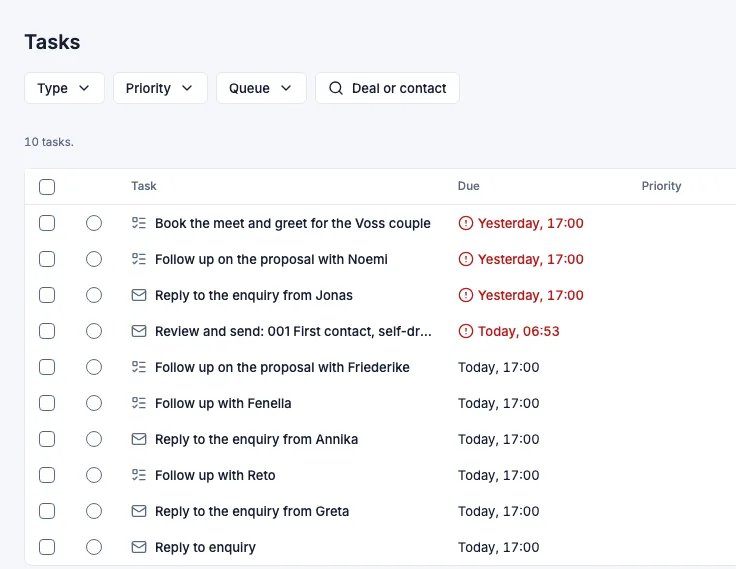
My day brings today's follow-ups and replies into one list, with the overdue ones in red. The promise in the first email should not slip because the afternoon filled up.
Rules can create the deal, the flag and the task. They cannot judge whether a camp suits a family with a young child. That stays with the consultant, which is why the sent reply should still sound like a person who read the note.
Safari Studio is sold as a monthly, quarterly or yearly subscription, with a free trial and no card needed. Plans and prices are on their own page.
If the gap you feel is the time between an enquiry and a clear reply, book a demo or start a free trial.