

Safari park fees pricing is one of the few figures on a quote that you do not set yourself, and it rarely moves on the same day as a lodge rate sheet. Owners, reservations managers and consultants spend the season fitting new tariffs beside quotes that clients already hold. If those quotes move without a decision, a family sees a different total from the one they approved. If the new sheet is stored properly, it only affects the trips that should use it.
A camp sends next year's rack rates. A park authority publishes a new conservation fee. A vehicle partner revises a daily rate. Clients often decided months ago, around school holidays or a booked flight, and they are holding a price. You still have to price the enquiry that arrived this morning.
This is about that split: updating supplier rates for the season ahead without breaking quotes you have already sent. It is written for owners, reservations managers and consultants who price trips for safari operators and DMCs across Africa.
Safari park fees pricing changes on its own calendar
Lodge rates and park fees do not share a year.
A lodge usually publishes bands: low, shoulder, high and peak. The dates behind those names differ by country, and often by property. A camp in the Okavango may call December peak. Camps in East Africa follow the migration, not the southern African green season. No company calendar can stand in for the sheet on your desk.
A national park, a conservancy or a concession holder sets entrance fees and conservation levies on its own calendar. The charge may be per person per day, per stay, or per vehicle. A new tariff may start on 1 January, on a financial year, or on a date in a PDF. That date will not always match the morning a lodge's high season begins.
For example, a lodge operator in the Okavango might receive a new high season rack in the same week as a park tariff that starts earlier than the camp's own change. Both feel like the new price. They do not cover the same nights.
Keep the cards separate. A new rack rate belongs on that lodge, for that year, in the season the lodge named. A new park tariff belongs on the days the guests are inside the park, at the figure in force on those days. The day the email arrived is not the start date of either.
What current should mean
Current has two meanings, and they conflict if they share one number.
For a new enquiry, current means the rate for the travel dates. A guest in camp next July needs that year's high season rack if those nights fall in high season, the commission agreed for that year, and the park tariff in force on the days in the park. Last year's peak is not a kindness. It is a price you may not be able to honour.
For a quote already sent, current means the price the client was given, until you decide to change it and say so. A higher rack for next year must not become a silent edit to a proposal a family is still discussing.
The usual failure is a paste. The new peak replaces the old because there is nowhere else to put it, and every trip that used the figure moves, including this year's departures on a rate the lodge has not withdrawn. Add the new year instead. Do not overwrite a year an open quote still depends on. Revise a sent quote only as a decision about that trip.
Store the year, then the season
Safari Studio stores a lodge's rates by year and by season: low, shoulder, high and peak, with the commission. The new sheet does not have to replace the old one.
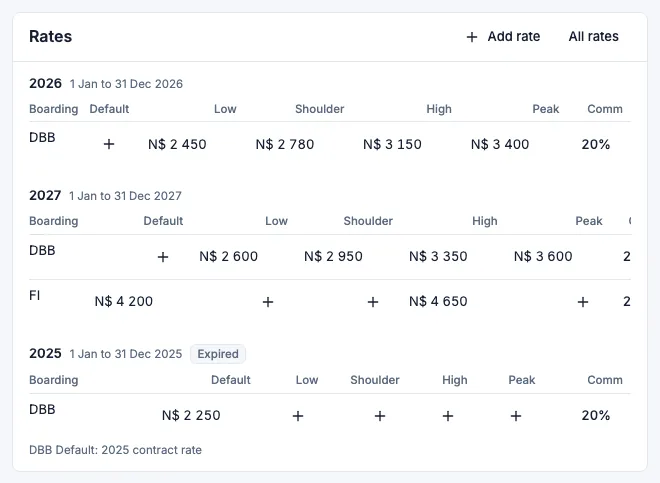
When the sheet arrives, add the year it belongs to. Enter the four seasons as the lodge defines them, and put the commission beside the rate it applies to. If the lodge has moved you from rack with commission to a nett rate, record that on the new year, not as an edit to a year you have already quoted.
Where a property's dates do not sit neatly on those four names, map them with care and keep the lodge's own dates beside you as you build the nights. A supplement on a few festive nights belongs on those nights in the costing, not inside a season name it does not match.
Park fees often never sit on the lodge card. Keep the tariff and its start date where the person pricing will see them, and apply the fee on days inside the park. Do the same for a vehicle rate or a guide rate that changes on its own contract: the new period sits beside the old one. New costings take the figures that cover their dates. A costing already sent changes only when you reissue it.
Work in this order:
- Read the dates before the numbers: which nights, which entries, which year.
- Add that year on the lodge, and leave other years as they are.
- Enter low, shoulder, high and peak, with the commission for that year.
- Note park and concession tariffs with the date they start, and how they are charged.
- Note vehicle and activity changes by the period they cover.
- Do not open old costings while you load rates. Decide that later, trip by trip.
Price the days, not the newest sheet
A current card does little if the quote is still one lump. The trips that stay right are built night by night, from the rates that match those nights.
You build the costing day by day, with your lodges, vehicles and activities at the rates you negotiated. The editor holds the client's details, the accommodation schedule at rack rates with commission, and the cost summary.
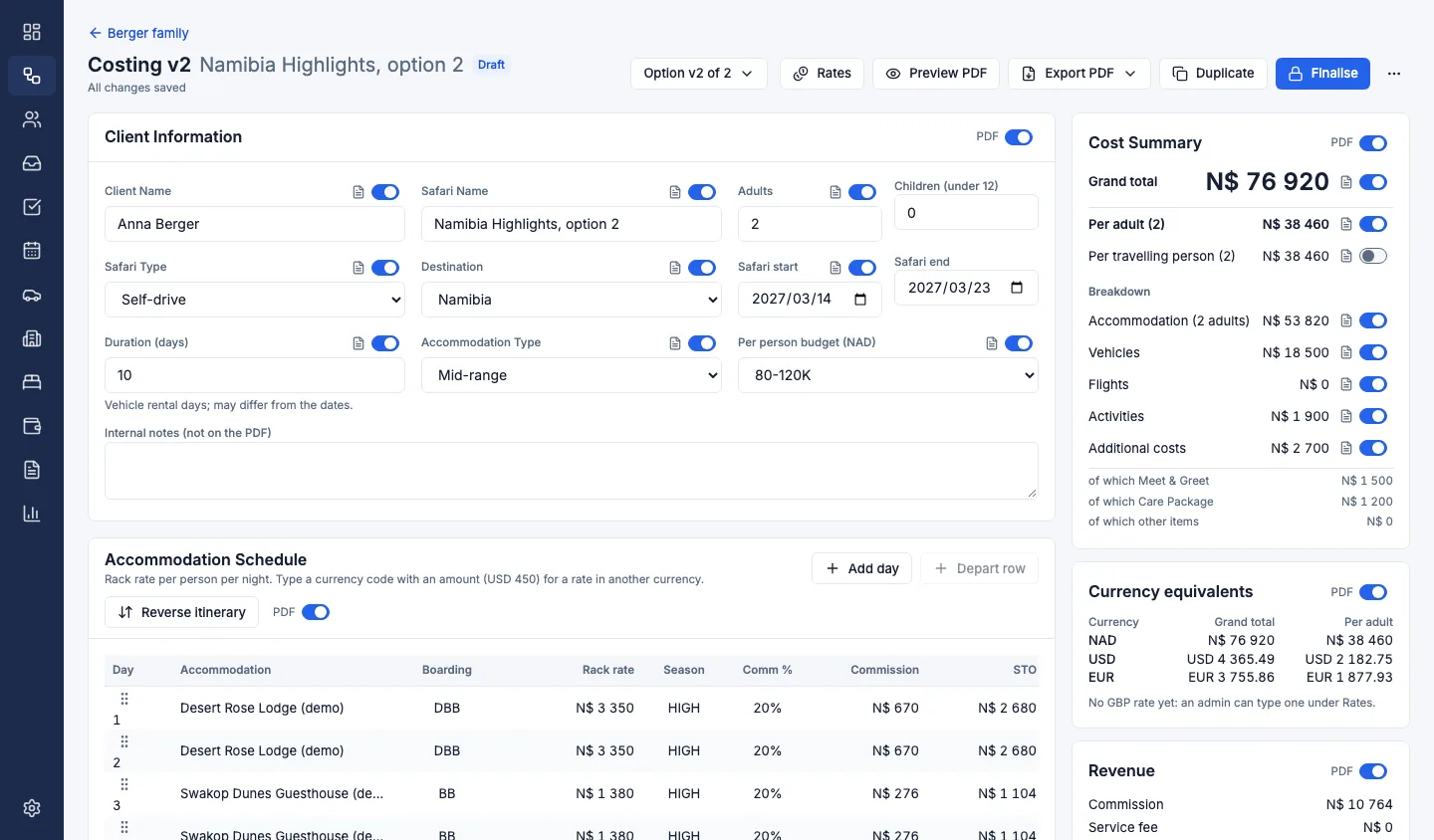
A park fee belongs on a particular day. If the guests enter on day three, the fee sits on day three, at the tariff in force then. Two parks mean two amounts. A vehicle fee charged once for the stay still needs a date, so a later reader can see why it is there.
The same pass covers the lodge night, the vehicle and the activities you promised. Refreshing only the accommodation still sends a stale park entry or a stale guide fee. A day by day costing makes a missing day obvious.
Each amount is stored with the exchange rate of the day, so the margin stays right when exchange rates move. You do not retype a sent quote because a currency shifted overnight. When you reprice on purpose, the new amounts store the rate of that day. Totals show per adult and in other currencies, and a costing PDF is ready to send.
Work as though the costing holds the amounts you entered. Adding next year's seasons is data entry for trips you have not priced yet. It is not a reason to reopen every deal. You change a sent costing by editing that costing, and only when you mean to.
Make the client quote from the same costing. Quotes made from the costing become deposit and balance invoices in any currency, so a revision and the later invoice share one set of figures. If a proposal is already with the client, regenerate that proposal from the costing so the page and the PDF match the costing you revised.
When a sent quote should move
Not every new sheet is a reason to write to the client.
Leave the quote as sent if the new card is for a later year, or for a season this trip does not use. Leave it if a park tariff starts after the guests have left, or before they arrive. Leave it if the lodge has confirmed a rate for this booking that the new rack does not replace. Leave it if the client has approved a price and your terms do not force a revision.
Open the costing if you quoted a provisional card and the final rate for those nights is now out. Open it if a park or concession fee on the travel dates has risen and your terms pass that fee on. Open it if the lodge will not honour what you sent, or if the client changes nights, camps or party size.
Loading the sheet does not make that call. For example, a reservations consultant might quote a July stay on a provisional rack, with the park fee at the tariff then in force. A higher final rack means a revision and a plain note on that trip only. A quote on a confirmed nett rate stays as it was sent.
If you do revise, revise the day rather than one line in isolation. Check nights, vehicle and activities, then read the summary. A partial edit is how a new park fee sits next to a total that no longer adds up.
If a room is still only requested or held, look at it before you reprice. The holds board shows each room as requested, held with an expiry, confirmed or released, and a chaser is ready before a hold lapses.
Read the summary before anything goes out
The summary is the check on a season update: grand total, amount per adult, the breakdown, currency equivalents and internal revenue.
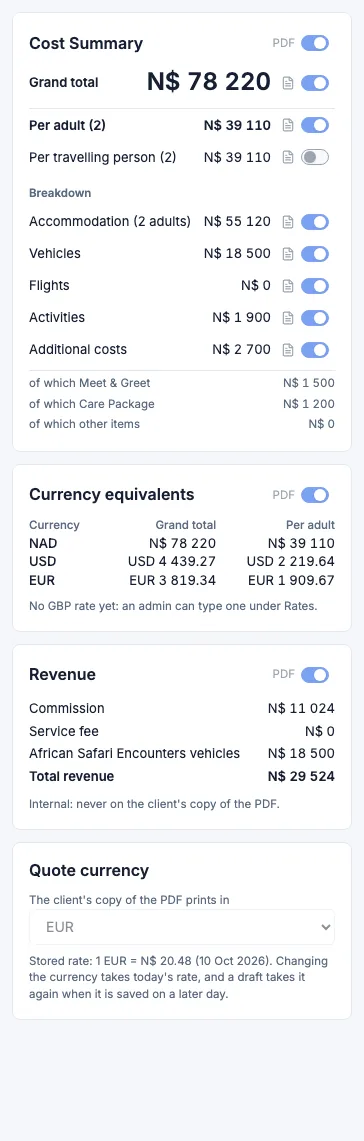
Start with the grand total. If you changed a park fee, the total should have moved by that fee, for the right number of people, and no further. A larger move means a night or a vehicle day changed as well. Read the amount per adult too. That is the figure many clients and agents set beside the previous version.
The breakdown is where a stale line hides. Accommodation can be current while an activity still carries last year's park fee. Open it even when you think you only touched lodges.
Currency equivalents follow the exchange rate stored with the amounts. They are not a prompt to reprice because the market moved this morning. Leave them unless this version is one you mean to send as new.
Internal revenue is for you, not the client. The season record holds the commission with the rate, and this figure should agree with it. Rack entered as nett, or commission counted twice, will make the trip look wrong. If you cannot explain the number from the sheet in front of you, do not send.
A routine the desk can repeat
When the next batch of sheets arrives, repeat the same steps. File each sheet on the right year and leave other years untouched. Enter the seasons and the commission. Note park fees with the date they start. Price new trips from the dates in front of you. Open an old costing only to reissue that trip, then read the summary and send the quote from the costing. When the client accepts, raise the deposit from that quote.
Typing the new peak into last year's row, or taking a park fee from the date of the email rather than the tariff, is how sent quotes move without a decision. Use the year on the lodge, and the date the authority actually named. One season name will not fit two camps on the same route. Price each night on the band that contains it.
Do not refresh the exchange rate on an old costing just because it is open. Amounts keep the rate of the day so the margin stays still. Change that rate only on a version you are knowingly sending again.
On a small desk, write the year onto the supplier even when you also hold it in memory. On a larger team, the person who loads rates should not open quotes, and the person who prices should touch only the deals you have listed. For example, a consultant pricing a camp in Zambia and a camp in Kenya in the same week is dealing with two calendars. Year and season on each lodge keep them apart.
Where the new figure is allowed to land
Keeping prices current is a question of where a new number may land. Put a lodge increase on the year and the season it belongs to. Put a new park tariff on the days it covers, on costings you are building or have chosen to reissue. Leave every other quote as the client saw it. Once a client has accepted, change that price only as a new version you have explained. If you absorb a supplier increase instead, leave the client's figures and let internal revenue show the difference.
Safari Studio is a CRM for safari operators, DMCs and the travel agents who sell their trips. Lodge rates sit by year and season, with commission, and each costing is built day by day at the rates you negotiated. Subscriptions are monthly, quarterly or yearly. Plans and prices are set out on their own page, and the trial needs no card.
To see a rate card beside a costing, book a demo or start a free trial.