

A booking rarely collapses in one conversation. It fades in the gaps: a Friday enquiry, a reply never quite written, a proposal that sits, a lodge hold that expires while the desk is on a transfer. A safari sales pipeline is the shared view that stops those gaps swallowing the season. It shows every open trip, who it is for, where it sits, what it is worth, and who needs to act next. For a small reservations team, that view has to survive a day split between quoting and operations.
Safari Studio is a CRM for safari operators, DMCs and the travel agents who sell their trips. Enquiries, mail, costings and proposals sit on the same deal. The pipeline is the work itself, not a second record you maintain afterwards.
A safari sales pipeline built around real stages
Stages help only when they match how a safari is sold. A label such as qualified or negotiation does not tell a consultant what to do before lunch. For each stage, the team should be able to say what must be true before a deal enters it, and whose job the next step is.
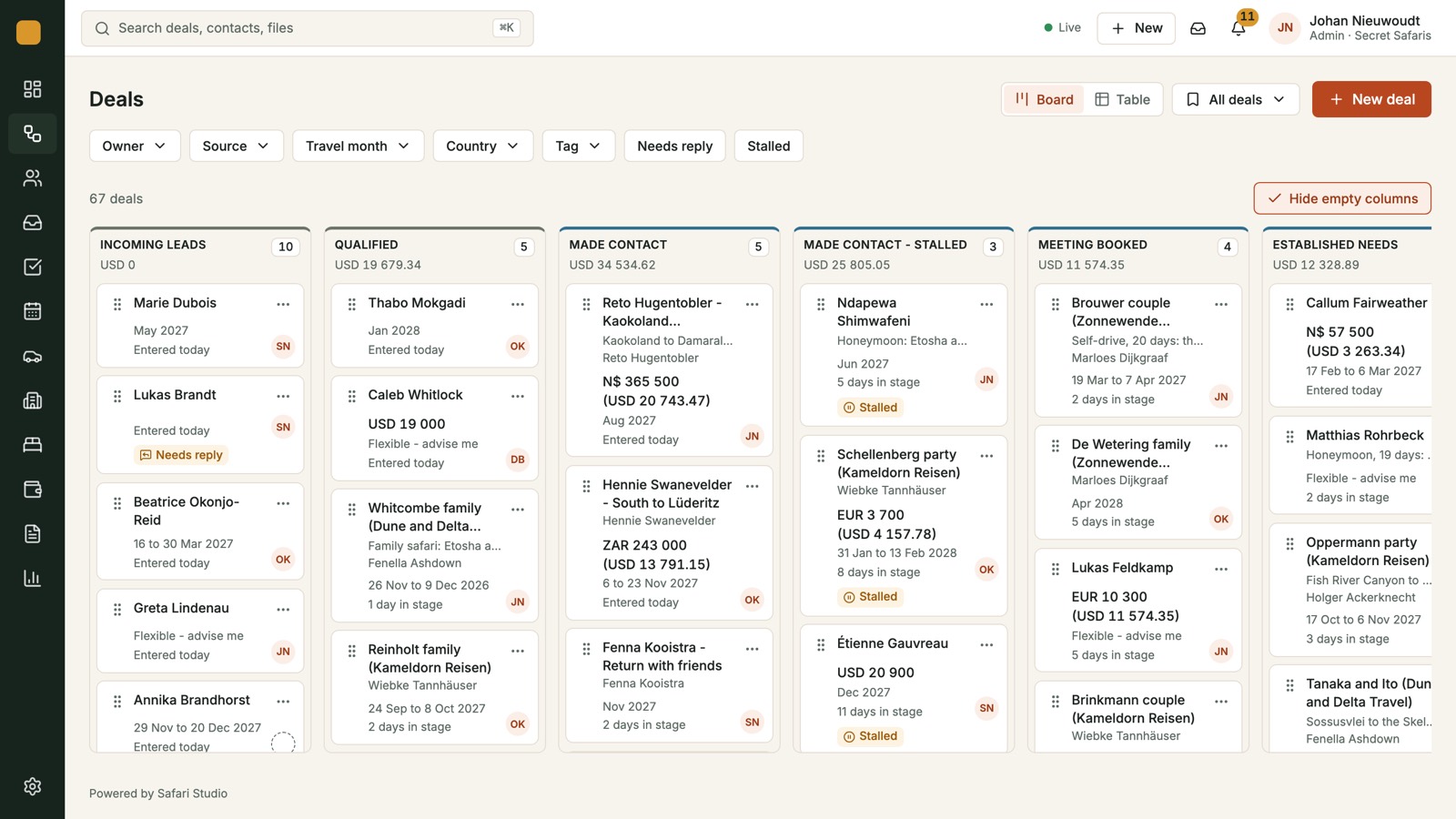
On the deals board for safari enquiries, website enquiries arrive as new deals, with the email thread linked. Nothing waits in a folder. You drag deals through your own stages. Columns run from Incoming leads to Established needs, and a deal's stage bar continues from Incoming leads through Proposal accepted to Tour completed. The sale, and the trip that follows, stay on one record.
Incoming leads
An enquiry is here when it exists and is not yet understood. It might be a website form, a message forwarded from a personal address, or a note from an agent. The work is a first reply, and a record anyone on the desk can continue: who is travelling, rough dates, and how they reached you.
Mail from every synced mailbox sits in one list, each thread linked to its client and deal. Gmail syncs both ways. Any other provider can arrive through a forwarding address. Needs reply flags mark threads where a client is waiting. At this stage that flag matters more than a forecast.
Established needs
A lead becomes a trip you can price when you know enough: party size, dates that are roughly fixed, the style of camp, and whether the route is a fly-in, a self-drive or a mix. For example, a lodge operator in the Okavango may only need parks, nights and a vehicle from the airstrip. A DMC may need the full route before a rate can be applied.
Cards show the client, the travel dates, the value in its own currency with the USD equivalent, and the days spent in the current stage. Deals can sit in any currency, with the value taken at the day's rate, so a desk selling in more than one currency can read the board without converting each card by hand.
Proposal accepted is not the end of the record
Once needs are clear, build the costing day by day: lodges, vehicles and activities at the rates you negotiated. Each amount is stored with the exchange rate of the day, so the margin stays right when rates move. One click turns that costing into the client's web page, a route map with drive times, lodge photos and a day-by-day story, in your brand, with a PDF alongside it.

Saying yes is not the same as a room held, and a room held is not the same as a tour run. The stage bar keeps those later steps on the deal, so the card does not vanish when the client accepts.
Every room you ask a lodge for can sit on the holds board, with an expiry on each one: requested, held, confirmed or released. Hold requests go out from the deal. Before a hold runs out, a chaser email is ready, so a lapse is a choice rather than a surprise.
A small team does not need a stage for every wobble. A short list, with a written test for each stage, is enough. If you are waiting, name what you are waiting for: a date, a decision, a lodge reply, a deposit. Vague stages hide stalls. Named stages show them.
Where deals stall between enquiry and booking
Most safaris that slip away are not argued away. They stall in a gap that feels like ordinary busyness.
The first gap is the unanswered enquiry. A form arrives while the usual person is out with a guide. By the next morning the thread sits under supplier mail and a client already in camp. The website form feeds the board, so the deal is already a card. Needs reply is flagged, so the waiting client is visible without a search. The inbox and the board are one conversation, not two queues to reconcile later.
The second gap is the proposal that went out and was never chased. The client liked the route, asked about another camp, and went quiet. Days in stage, on the card, show how long the quiet has lasted. Stalled deals and unanswered mail are flagged, so the silent cards surface without an audit of every thread. Flagged does not mean lost. It means someone should decide: chase, wait for a dated reason, or close it.
The third gap is the hold that expires while two people each assume the other is watching. Camps do not keep rooms out of politeness. An expiry, with a chaser prepared before that date, turns a lapse into a decision. If both facts live on the deal, the handoff does not depend on a corridor conversation.
The fourth gap is internal. One person holds the costing. Another holds the latest mail, because the client replied to an address that was never shared. Two-way Gmail sync keeps every reply beside the trip, and a forwarding address does the same for other mailboxes. Whoever is covering can read the thread, see the stage, and answer in the right signature.
Won and lost totals only help if lost is used. A deal left in a middle column because closing it feels abrupt will not travel, and it trains the desk to distrust the board. A plain reason on the card is enough.
Look for stalls in time, and in the missing next action, not in how keen the client sounded. Enthusiasm is not a stage. A dated task is.
Follow ups that do not live in one person's head
Follow up is where the sale usually settles, and it is the first task dropped when a flight changes. The aim is not more mail. It is a next action that exists when the person who knows the client is out.
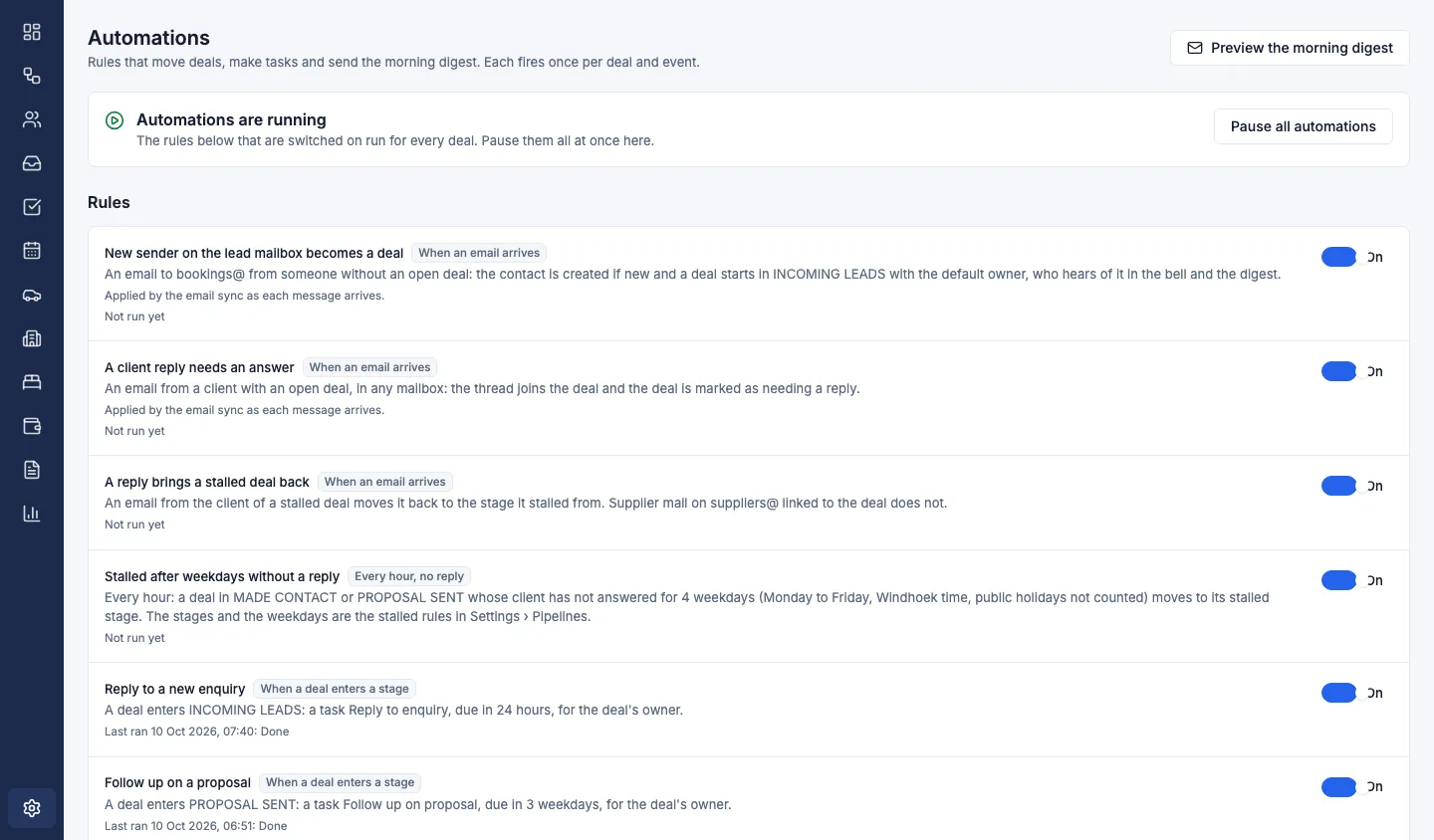
Rules can turn new emails into deals, flag replies, move stalled deals and create follow-up tasks. Used lightly, they remove the copying a small desk never finishes. A new email becomes a deal. A reply is flagged. A deal that has sat too long gets a task, so it cannot hide in a column nobody is scanning.
Each morning, clear what needs a reply. Those clients are waiting, and they come before the newest enquiry. Name their dates and the open question. Templates cover the routine notes: a first acknowledgement, a request for dates and party size, a line that the proposal is coming and when you will write again.
Twice a week, walk the board from the right. Start with deals closest to a decision, not with the unfamiliar new enquiry. For each card, ask what the next action is, and whether it has a date. If nobody can answer, the deal is stalled.
Agree how long a sent proposal may sit before someone writes. The gap depends on how soon the travel is, and on how quickly lodges reply. Store that gap as a task, rather than leaving it to whoever remembers the name.
After acceptance, you are confirming rooms, not asking for a decision. A quote made from the costing can become the deposit invoice on the same deal, so a won stage does not conceal what is still unbilled. Do not let that work replace the stage review.
What the board should tell you each week
The desk needs a sharper question than a single pipeline total: which deals need a person today, and whether open trips match the season you are trying to fill. Both come from the same board, if the stages are honest.
The stage funnel shows deals and their value in each open stage, with open, won and lost totals. That is enough for a weekly talk. You can see that work is stuck before a proposal, or that value sits in deals nobody has touched, without a separate sheet. You are noticing a pile-up, not forecasting the year.
A pipeline snapshot lists deals and their value per stage, weighted by each stage's probability. If those probabilities are still a guess, treat the weighted total as a reason to inspect a stage, not as a figure to promise anyone.
The conversion funnel shows how many deals entered each stage, how many went on, and the median days in each. If Incoming leads usually move quickly and the median is stretching, the bottleneck is the first reply. If proposals go out and then sit, the stall is after sending.
Plans are on the pricing page. Safari Studio is a monthly, quarterly or yearly subscription, with a free trial and no card needed.
Habits that keep the pipeline true
The test is a busy month, when the same people are quoting, holding rooms and solving problems for guests already travelling. If the board is wrong that week, everyone returns to private inboxes.
Move the card when the work changes, not in a Friday batch. Anyone covering midweek will trust the mail more than stale columns, and you will have two systems again.
One owner per deal, even when the work is shared. If they are out, the linked thread and the stage should be enough for a holding reply.
Let the stage sort the morning, not the headline value. A large itinerary still in Incoming leads is less urgent than a modest trip with an accepted proposal and a hold expiring this week.
You can book a demo or start a free trial and set the stages to the way your desk already sells.