

Private journeys rarely fail in the brochure. They fail when a vehicle is promised twice, a villa hold lapses while the client is in the air, or a guide's rest day sits in a notebook. If you design expeditions, yacht weeks with land travel beside them, or villa stays with long transfers, the booking is only the visible part. This piece sets out what to look for in adventure travel booking software when the trip is not a standard circuit: vehicles, people on the ground, rooms that expire, and one calm answer for the client.
Safari Studio is a CRM for safari operators, DMCs and the travel agents who sell their trips. It is a monthly, quarterly or yearly subscription, with a free trial and no card needed. Expedition work throws up the same shape of problem: a fleet that must not clash, rooms that must be held, a costing that can move, and every reply kept on the deal. It is not a yacht management system. The fair test is which jobs you need, and which of those jobs you can see it do.
What adventure travel booking software has to hold
A generic calendar can show a departure date. It cannot tell you whether the Land Cruiser is in for a service, whether the camp has confirmed the tents, or whether the deposit invoice is still open. For a designer, adventure travel booking software is where those facts sit next to the client.
The trip has to be a deal, not a row. Website enquiries should arrive as new deals, with the email thread attached, so nothing waits in a folder. For example, a request for a private desert crossing should land on the board the day it is sent. In Safari Studio, mail from every synced mailbox sits in one list, each thread linked to its client and deal. Gmail syncs both ways. Any other mail provider can come in through a forwarding address. Needs reply flags mean a client does not sit unanswered. Email templates and signatures are there for every person and mailbox.
Resources have to be bookable: vehicles, rooms, and blocked days. A description of the trip, with the real plan still in a sheet, means the sheet wins every argument.
Money has to travel with the plan. A quote that is not built from the costing drifts when a rate moves. Each amount should be stored with the exchange rate of the day, so the margin you agreed is the margin you still have.
The page the client sees has to be yours. Your logo and colours, a route they can follow, a PDF when they ask. On Pro and Max, clients never see Safari Studio on proposals, quotes, invoices or the client form. Lite adds a small Powered by Safari Studio line.
Vehicles that cannot be in two places
On an expedition the vehicle is the trip. A private family may need a car and a support vehicle. A small group may need a set of 4x4s that stay together, plus a workshop day for one of them. A yacht week with a land extension still needs a car at the quay on a named morning. If two designers can assign the same vehicle and the system stays silent, you have a shared diary, not a booking tool.
Look for one timeline: one row per vehicle, trips as bars across the dates, services and blocked days on the same line. The clash should show when you assign the car. Tentative holds matter as much as confirmed bookings. A vehicle pencilled for a recce is not free. A vehicle blocked for a service is not free because sales were not told.
Safari Studio keeps every vehicle on one timeline with its trips, services and blocked days. Assign a car to a trip and the clash shows before it happens. That is what the fleet timeline is for: no 4x4 booked twice.
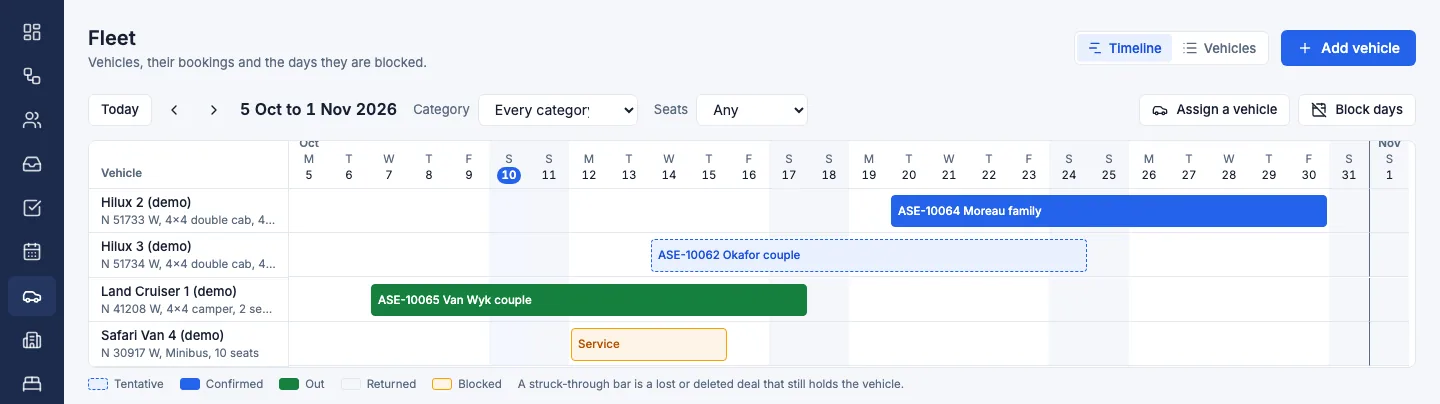
Each row is a vehicle. Bookings, tentative holds and service days sit on the dates. For example, a designer building a two-week overland journey can place the lead vehicle and the support vehicle together and see a service overlap before anyone is promised a seat.
In a trial, book the same vehicle on overlapping dates, then drop a trip onto a service day. A colleague should be able to see the hold without asking you.
Guides need their own question. Many operators still assign them in a notebook, or in a column beside the vehicle. Safari Studio's fleet view is built for vehicles, services and blocked days, not as a guide roster. Ask where guide days, leave and overlapping departures appear. If they are not on the screen, name the person who checks clashes, and do not pretend the vehicle timeline has done it.
Holds and the dates that decide each other
A private journey may hold a villa, then a mobile camp, then a lodge after a long drive. A yacht charter often needs a land night before boarding and another after. The failure is familiar: the hold expires while you are with another client, or out of signal.
Look for a board, not a chain of emails: requested, held with an expiry, confirmed or released, with a chaser ready before the date and the request sent from the deal. On the holds board, every room you ask a lodge for sits in one of those states. A chaser email is ready before the hold runs out, and requests go to each lodge from the deal. That matches a camp or lodge night you book. It is not a berth planner. If a yacht company holds the charter, keep that note on the deal and use the board for the nights you book.
Those dates then need one month, not five tools. Hold expiries, vehicle bookings, trip dates, meetings and invoice due dates decide each other on a remote journey. You cannot confirm Friday's cars if Thursday's villa hold has lapsed and the deposit that releases your supplier payment is still open.
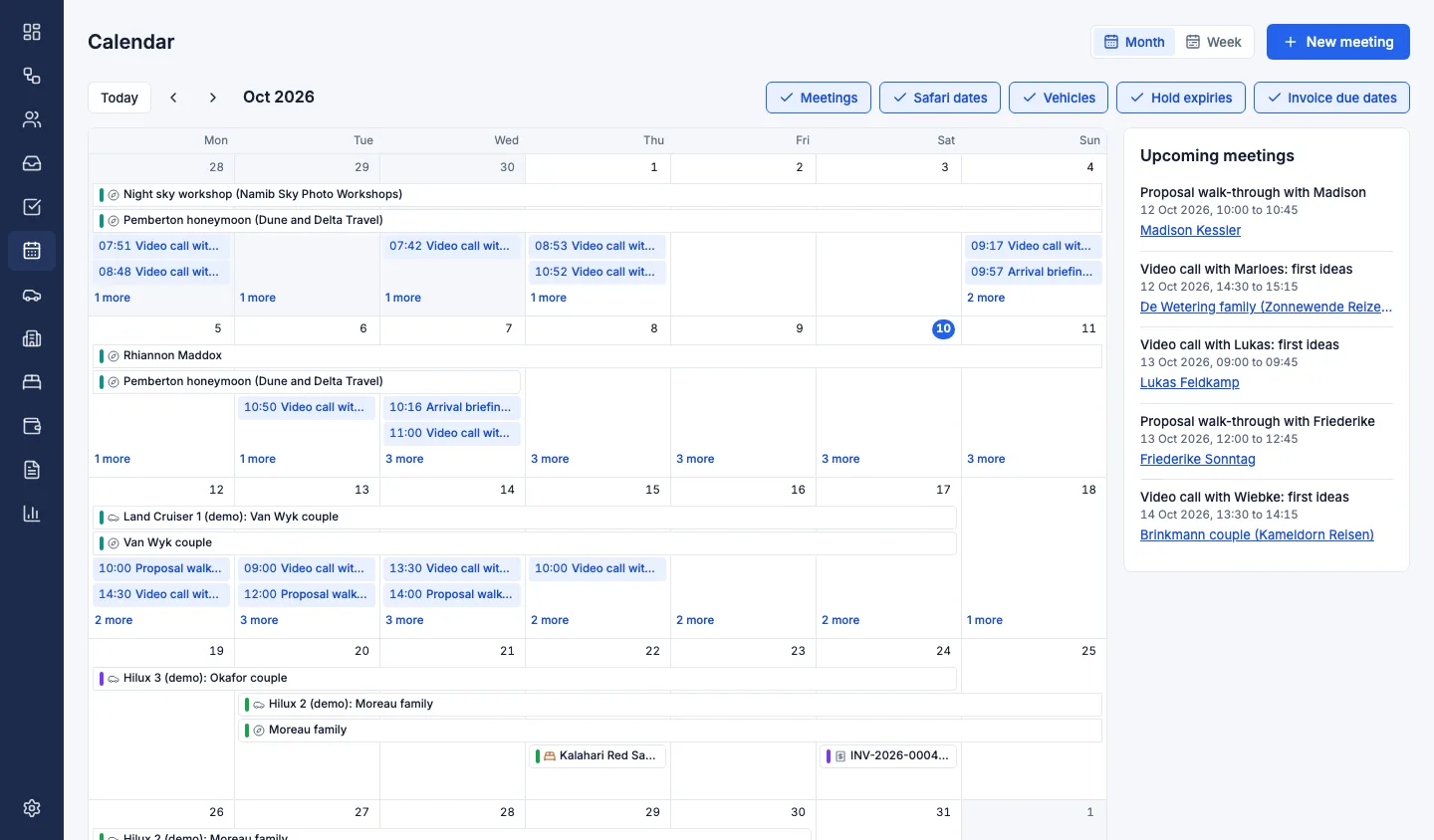
For example, two villa nights, then a week on the road: the hold ends Thursday, the vehicles run from Friday, the deposit is due the same week.
Costing, payment and the page they read
Routes change. A track closes, a night is added, the vehicle is in one currency and the lodge in another. Build the costing day by day, with lodges, vehicles and activities at the rates you negotiated. Store each amount with the exchange rate of the day, so the margin holds when rates move. Totals per adult, totals in other currencies, and a costing PDF you can send, are the practical outputs.
Day-by-day costing in Safari Studio is that screen. It will not add a permit fee you forgot, and a guide's rate appears only if you enter it as an activity. Put the vehicle, the lodge and the activity on the right day, and a route change is an edit. In a demo, move a day, swap a vehicle, change one foreign currency amount, and read the margin. If the old rate has vanished, or you must retype the total, the second amendment will send you back to the spreadsheet.
Quotes should come from that costing, not from a figure typed beside it. Quotes, invoices and payments turn the quote into a deposit invoice and a balance invoice, in any currency, with a card payment button. Every payment is tracked on the deal. Late payments are grouped by how late they are. Keep both invoices on the deal, in the currency you billed.
The client should see the journey, not the grid. One click turns the costing into their web page: a route map, drive times between stops, lodge photos and a day-by-day story, in your brand, with a PDF alongside. That is what proposals and route maps do. Branding puts your logo, colours and one of four theme presets on the proposal, the quote, the invoice and the client form.
Be plain about what the map is. Drive times and lodge pages describe the land route you costed. Days on a yacht belong in the story you write. The software will not plot a sea passage, and a lodge photo is not a cabin. The page the client reads, and the page an agent forwards, stay tied to the costing.
From a hard-to-reach week to a number you trust
The sales problem sits beside the logistics. You may be on a recce when the next enquiry arrives. It should land on the deals board as a new deal, thread attached, ready to drag through stages you define. Stalled deals and unanswered mail should be flagged. Any currency, valued at the day's rate, lets you compare a dollar trip with a sterling one without a side calculation.
The inbox keeps synced mail in one list, with templates, signatures and needs reply flags. Two-way Gmail sync leaves every reply beside the trip.
A pipeline snapshot shows deals and their value per stage, weighted by each stage's probability. A funnel shows how many deals entered each stage, how many went on, and the median days in each. Automations can turn new emails into deals, flag replies, move stalled deals and create follow-up tasks, which is how a small desk covers the hours the designer is out.
Plans are monthly, quarterly or yearly, with a free trial and no card needed. What each one includes, and what it costs, is on the pricing page.
What to ask, with a real file open
Take a private departure into the conversation: two vehicles, a service day, a hold that expires, a foreign currency rate, and four emails already on the thread.
- Does assigning a vehicle show a clash, including against a service day or a tentative hold?
- Does each room hold have a status, an expiry, and a chaser ready in time?
- Can hold expiries, vehicle bookings, trip dates and invoice due dates share one month?
- Can you cost day by day, keep the exchange rate on each amount, and send a costing PDF?
- Does the proposal come from that costing, in your brand, with a PDF that matches?
- Do enquiries become deals with the mail attached, and are stalled deals and unanswered replies flagged?
- Can the quote become a deposit invoice and a balance invoice, with payments on the deal?
- Where do guide days live? If they are absent, who checks them before you confirm?
Fail the clash test or the hold test and the rest is decoration. A missing car, or a room released while you thought it was held, is how an expedition promise breaks.
Safari Studio is built for safari operators, DMCs and the agents who sell their trips. If your journeys turn on vehicles, camps, villas and dated holds, try those screens on a live file. If the heart of the product you sell is yacht inventory or a guide payroll, buy only what you can see working.
You can book a demo and walk a current journey through the fleet, the holds and the costing, or start a free trial and lay a month of vehicles on the timeline yourself.